
Stop Starting Over With Your Podcast Editor
Your podcast deserves a production team, not a revolving door of freelancers.
You know the cycle. You find a great editor. A few months in, replies get slower. Three-day turnarounds become nine. The sound starts changing from episode to episode. Then your editor takes on a bigger client, and suddenly you're back on Upwork at 11 p.m., explaining your podcast to someone new.
Resonate gives you a dedicated team of degree-trained audio engineers who handle the entire post-production process, from editing, mixing, and mastering to video post-production and distribution across every major platform. Your episodes are typically delivered within 3-5 business days, every time, with a team behind you to keep things moving when someone is out. No disappearing editor. No growing queue. No starting from scratch every few months. Just consistent, professional production from a team that knows your show.
Trusted for audio and video post-production alike
The companies behind shows we have produced.










Nothing is wrong with your editor. Something is wrong with your arrangement.
Plenty of brilliant editors work freelance, and you've probably hired one. The problem isn't talent, it's that whoever carries your entire publishing schedule alone has no slack in it anywhere. Here's how that shows up for you.
Your editor is a single point of failure
A holiday, an illness, a family emergency, a bigger client. Any of those and your show stops. You have nobody to hand it to, because the process lives in one head.
Your turnaround quietly stretches
It starts at three days. Then your editor takes on two more shows and it becomes nine, and you find out on the day you were meant to publish.
Your episode twelve does not match your episode three
Without your preferences documented somewhere the whole team can see, decisions drift: loudness, music beds, how tightly gaps get cut. Your listeners feel the inconsistency even when they cannot name it.
You re-explain your show every time
Every replacement editor means rebuilding the brief, the intro conventions, the guest name pronunciations, and the things you already asked twice not to cut.
Video becomes your problem too
Most audio editors do not cut video, so you end up managing two vendors from one recording session and reconciling their timelines yourself.
Managing them becomes your job
Chasing, re-briefing, re-uploading, checking. You did not add a podcast to your week to acquire a second job coordinating it.
Your audio and video, produced to the same standard by the same team.
Most agencies pick a primary format and treat the other as an upgrade, and it shows in the output. We treat both as core services, working from the same recording session you already have, so you don't need a second vendor to coordinate.
Editing
We remove your mistakes, filler, false starts, and dead air, then arrange the structure so your episode moves. We cut on meaning rather than on silence, which is the difference you can hear in the samples below.
Mixing
We balance the levels between your hosts, guests, music, and effects, so nobody is shouting and nobody disappears. We handle room tone so your remote guest doesn't sound like a phone call.
Mastering
We set your final loudness and format to streaming platform specifications, around negative sixteen LUFS, so your episode doesn't arrive quieter or harsher than everything else in the feed.
Video Post
We sync your footage to the audio track, cut between camera angles, apply color-safe adjustments, and export both a long-form YouTube cut and short-form social clips from the same session.
Anyone can cut your episode. Not everyone can hear where to cut it.
The cheapest freelancer and the fastest AI tool share the same weakness: both remove what looks wrong rather than what is wrong. Below are three raw clips from real shows, each run twice: once through the automatic edit on a widely used AI editing tool, once through a Resonate engineer. Same source audio, same episode, no cherry-picking. In every clip you'll hear the AI version first, then ours. Listen on decent headphones if you have them.
Where the cut lands
AI cuts on silence. Our engineers cut on meaning, which is why you'll hear one version keep the breath before the point while the other removes it.
What counts as a mistake
Not every "um" is a flaw and not every pause is dead air. Strip them all out and your conversation starts sounding like a press release read aloud.
How two voices sit together
Levels, room tone, and the handoff between speakers. It's the part your listeners never consciously notice until it's wrong.
The AI edit, first half of each clip. Fast, cheap, and genuinely useful if you just need a rough pass. It does exactly what it's told and nothing more.
The Resonate edit, second half. Your episode goes through degree-trained engineers, Dolby Atmos and iZotope RX certified, in three to five business days. You get judgement, not just processing.
A production team you can count on.
Transitioning to a new team takes time. We make sure it's worth it. Here is exactly what the handover looks like.
We listen to your last three episodes
Before you send anything new. We work out how your show is currently cut, where the loudness sits, and what your intro and outro conventions are, so the handover is invisible to listeners.
We learn how you want your show to sound
When you come on board, we ask about your editing preferences, style, and expectations, then make sure those notes are available to the team working on your show. That way, your production stays consistent from episode to episode, even when more than one person is involved.
Keep your publishing schedule moving
Switching production teams takes a little time. We work with you to make the transition without putting your publishing schedule on hold, so you can keep releasing episodes while we get your new workflow up and running.
Credentials matter less than consistency for your show. We happen to have both.
A certificate doesn't make your episode sound good. A documented process, your preferences on file for the whole team, and enough engineers to cover each other is what keeps your episode two hundred sounding like your episode one.
We still think the credentials are worth telling you about, because they're the reason our process is what it is: Dolby Atmos Mixing, Pro Tools, and iZotope RX certifications, formal degrees in recording arts, and multiple shows we've helped bring to number one on Apple Podcasts since 2014.
Book a Strategy Call →per episode, from a team with cover, not one freelancer's queue.
Dolby Atmos Mixing, Pro Tools, and iZotope RX on the editing team.
of weekly podcast listeners use YouTube as their preferred platform.
The year Resonate started editing audio and video podcasts professionally.
Build the package that fits your show. One team, one standard.
Podcast editing services covering editing, mixing, mastering, video post, and distribution are the core of what you get on this page. If your show also needs strategy, a producer, or full-scale distribution, you can get those from the same team rather than adding another vendor to manage.
Podcast Launch
Starting from scratch? Our launch support covers your strategy, format, and first ninety days, so your editing has a clear direction from episode one instead of being invented as you go.
Learn morePodcast Management
A dedicated producer keeps your recording, editing, and publishing on schedule, so nothing sits waiting for you to remember to chase it.
Learn morePodcast Marketing
Get audiograms, videograms, and full episode transcripts from the same files your production team already delivered. Transcripts also make your show readable to search and AI answer engines.
Learn morePodcast Hosting
Publish your finished audio and video to Apple, Spotify, YouTube, Amazon Music, and iHeart Radio simultaneously, with analytics on both formats in one place.
Learn moreWhite Label for Agencies
If you run an agency offering podcast services to your own clients, use this editing team as your production backbone without building in-house capability or hiring engineers.
Learn moreNarrative & Sound Design
If you're producing an investigative or narrative show, layered sound design, music beds, and effects turn your straightforward recording into something people finish in one sitting.
Learn moreShows edited and finished by the team that would work on yours.
Founder-led audio, practitioner deep-dives, and enterprise internal communications, all through the same post-production process you'd get.
GO AI Podcast
A founder-and-team-led show for a marketing agency navigating AI-powered growth strategy. Produced by Resonate for a team that wanted a consistent, high-quality audio channel without building an in-house studio.
This is what a fully edited, mixed, and mastered founder-led show sounds like when the post-production process is the same every single week.
Listen on Apple Podcasts →Shared Practices, Your Dental Roadmap
A practitioner-focused show for dental professionals navigating practice ownership, growth, and transition. Produced by Resonate since launch, the show has built a loyal, returning audience within its niche.
A long-running show depends on post-production quality holding up at episode two hundred, not just for the pilot everyone was excited about.
Listen on Apple Podcasts →Better by Great Place to Work
A branded podcast for Great Place to Work, the global authority on workplace culture, interviewing executives and people leaders on building high-trust workplaces. Produced and managed end-to-end by Resonate.
Enterprise shows need the same reliable standard as any other show, just with more stakeholders reviewing the final cut before it goes out.
Listen on Apple Podcasts →Still deciding? Bring us the episode you are least happy with.
Play it to us on the call. We will tell you what we would have done differently and how long it would have taken, before you commit to anything.
Common questions you might have about podcast editing and post-production.
Everything worth knowing before you send us your episode.
Book a Strategy Call →What is podcast post-production?+
What is included in podcast editing and post-production?+
Why hire an editing team instead of a freelance podcast editor?+
How long does podcast editing take?+
Why does human editing still matter if AI tools can edit a podcast?+
What is the difference between editing, mixing, and mastering?+
What credentials does the editing team hold?+
Can I switch editors in the middle of a season?+
Can an agency white-label podcast editing?+
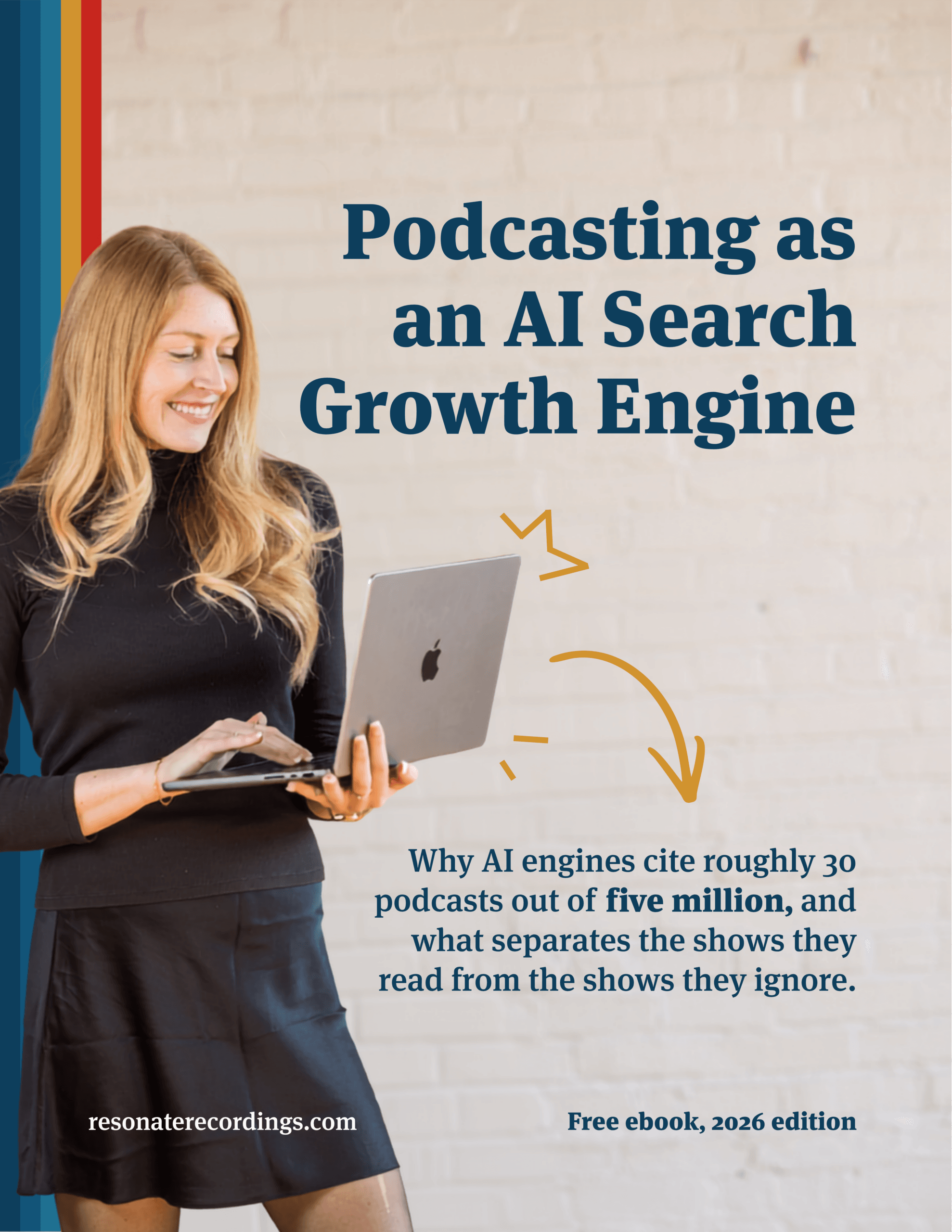
Good editing isn't just for your listeners anymore. AI engines read your show too.
We ran a six-month study logging 5,214 citations across ChatGPT, Claude, Gemini, Perplexity and Google AI Overviews to find out which podcasts they actually pull from. The shows that lost mostly didn't lose on content quality. They lost because the words never existed on a page a crawler could read, which is worth checking for your own show.
- Why transcripts decide more than audience size does
- The five-point spec every top-cited show shares
- Six ways branded podcasts get built that AI engines can't read
- A 90-day sequence you can run without hiring anyone
- A full sources page, every figure attributed
Nine pages. No credit card, no call booked, no drip sequence you cannot leave.
Need a full production program instead of just editing?
If your organization needs strategy, launch support, and ongoing production rather than post-production on a show you already run, these pages cover the positioning details for your sector.
You did not start a podcast to manage an editor.
Hand it to a team and get your week back.
Thirty minutes on your show, your schedule, and what a handover would actually involve. No pressure to move if the timing is wrong.
No commitment. Thirty minutes. An honest answer about whether we are a better fit than what you have now.