
Biotech podcast production that helps people hear why your science matters
Biotech podcast production gives your scientists room to explain big ideas in their own words. Investors, partners, and recruits all want to understand what you’re building.
Your team brings the science. We’ll handle the show around it.
Why is biotech so hard to explain in a press release?
Inside the lab, scientists speak in precise, technical terms. Outside it, investors, partners, and patients need a clear picture.
A press release can’t carry much nuance. A conference talk only reaches the people in the room.
A podcast gives your founder or chief scientific officer forty minutes to explain how the work started, what you’ve learned, and where it’s heading. That’s a lot more room than a slide, and you won’t need a laser pointer.
Who listens to a biotech show?
Most shows serve one or two of these groups well. We’ll help you pick which ones matter most right now.
| Listener | What they’re listening for |
|---|---|
| Investors and analysts | How leadership thinks, and whether the team sounds credible. |
| Partners and collaborators | How your platform works and how your team approaches a hard problem. |
| Clinicians and researchers | Scientific depth and honest insight from peers. |
| Patients and advocacy groups | Honest information, minus the hype. |
| Scientists you’d love to hire | The science and the culture. A show can carry both. |
Which formats suit a science story?
Start with one or two that suit your team, and we’ll shape a season around them.
The founder’s story
Why the company exists, what problem drove it, and what keeps the team going.
The science explained
A scientist walks a smart non-expert through one concept, with a good analogy or two.
Across disciplines
A chemist, a clinician, and a data scientist look at the same problem from three angles.
The field conversation
Leaders from other companies and academia talk through trends and open questions.
Lab life
Early-career scientists describe a typical week. Recruits love hearing who they’d work with.
The patient voice
With care and consent, advocates share what matters most to them.
How do we explain the science without overstating it?
Great science talk respects the listener. And because claims about efficacy, safety, or timelines carry weight, your own reviewers stay in charge of what’s said.
Explaining without dumbing down
Our producers sit down with each scientist before recording. They’ll ask what a thoughtful outsider would ask.
- Find the clearest analogy for a tricky idea.
- Flag jargon so terms get defined on mic.
- Edit by ear so the explanation flows.
Your reviewers decide what’s said
Your regulatory, legal, and medical teams set the rules. We’ll build their review into the schedule.
- Agree on off-limit topics and guest briefings first.
- Reviewers listen, mark timestamps, and approve.
- Your approver’s sign-off comes before anything’s published.
- We don’t give regulatory advice, and we never add claims.
Production handled while your team stays in the lab
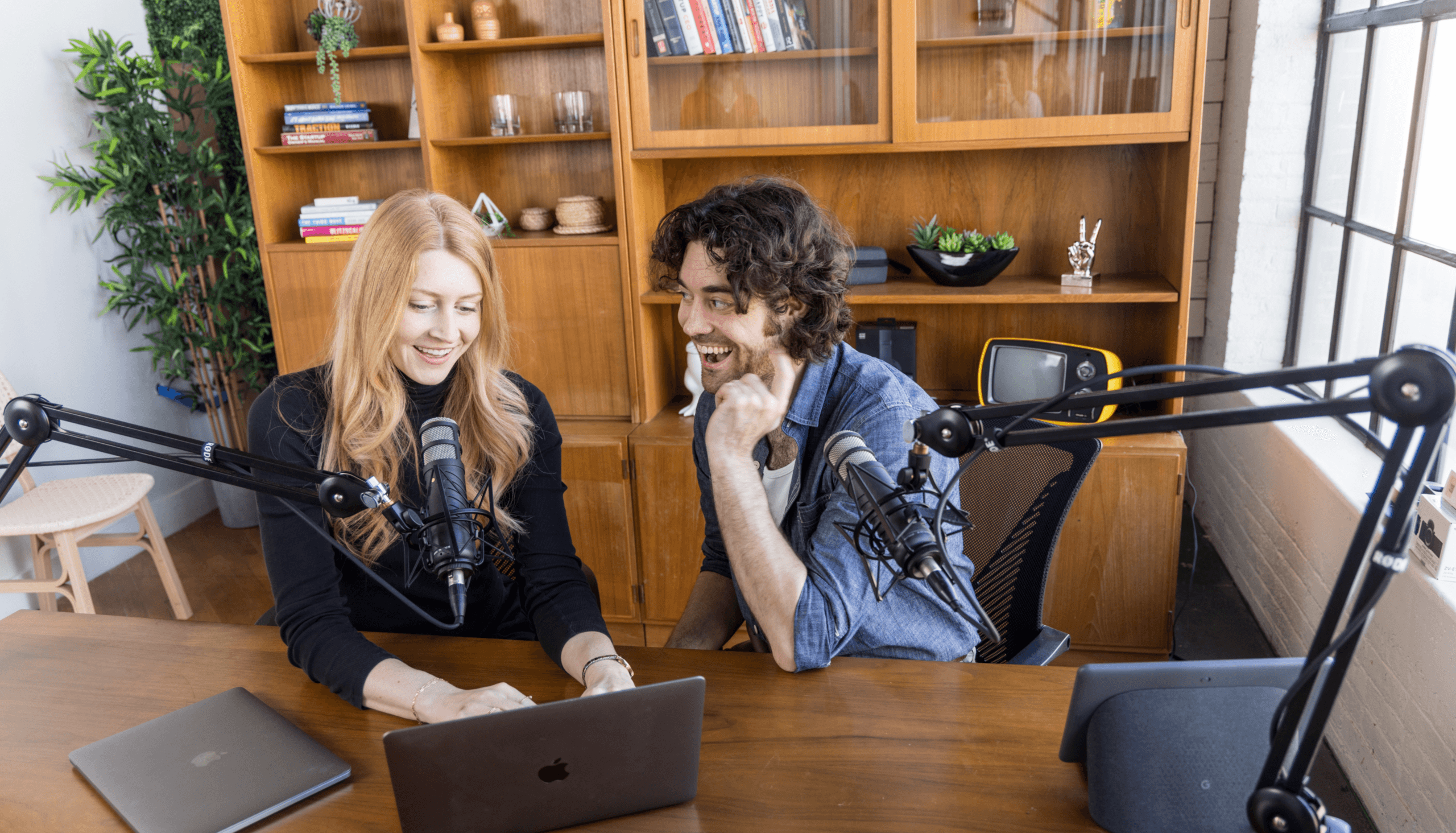
You bring the scientists and the story. We’ll take care of the rest, from first mic check to published episode.
- Launch: our podcast launch services shape the strategy, name, artwork, trailer, and distribution.
- Editing: degree-trained engineers behind our podcast editing services usually turn episodes around in 3 to 5 business days.
- Video: video podcast production gives you captioned clips for LinkedIn and investor channels.
- Producing: with podcast management services, a producer schedules your scientists and preps each guest.
- Written extras: show notes and transcripts, handy when the vocabulary gets technical.
- Hosting: podcast hosting for business for the public show, or a private feed for partners.
Let the show carry the story between big moments
A biotech company has natural moments: a financing round, a data readout, a conference. Here’s one way a season can follow them.
Before the conference
A short series gives attendees context before they walk in.
After a milestone
A conversation about what the news means and what’s next.
Between the headlines
Science explainers keep the story going when the news is quiet.
Review first
Your legal and regulatory teams check every episode before release.
What if a season followed a single research question?
One question can fill a short season. Why this target, why now, what was tried before, and what comes next?
Each episode covers one step, told by the person who took it. A computational biologist talks about the data, a chemist about the molecule, a clinician about the patient need.
It’s a story-driven podcast format, and listeners get to see how the pieces fit. Your review team still checks each episode first.
Who else should hear your science before it goes public?
Some conversations belong with a smaller audience, like your advisory board, partners, or investors. A private feed keeps those episodes out of public directories.
They listen on the player already on their phone, by invitation only, and your public show keeps its own lane.
A private feed for lab teams and advisors
Private podcast hosting delivers episodes to invited listeners only, whether that’s your own staff or an advisory board.
- You control who gets access.
- No audio is fully private, since anyone who hears it can record it.
- Keep confidential data and unpublished results out of the audio.
A sensible first season
Six to eight episodes is a comfortable start.
- Open with the founder’s story.
- Alternate science explainers and cross-discipline talks, plus one lab life episode.
- Track listens, partner replies, and mentions in investor meetings.
What can a podcast do for a biotech company?
A podcast won’t raise a round, and it won’t stand in for data. What it adds is a voice and a personality behind the science.
It does need a few scientists who enjoy teaching. If your best researchers would rather be at the bench, a guiding host can lead the conversation instead.
Questions from biotech teams
Can we talk about our pipeline?
That’s your regulatory and legal teams’ call. We’ll shape each conversation within their guidance, and our podcast production services build their review into every episode.
Can academic collaborators join the show?
Yes, with their permission. We’ll help you plan the invitation, and our podcast manager preps each guest before recording.
Do you book guests?
We don’t book guests. We’ll draft the outreach copy and the questions, then prep each guest. Your team sends the invites.
Can we keep an episode just for partners?
Yes. A private feed only opens for the people you’ve invited, so it’s a nice fit for partner updates.
How is this different from a pharma show?
Biotech shows usually center on early-stage science, investors, and recruiting. For commercial-stage brands with formal review cycles, see our pharma podcast production page.
Can a show reach clinicians too?
It can. If clinicians are your main audience, our healthcare podcast production work covers that angle in more depth.
What would it cost?
That’ll depend on how many episodes you’re planning and whether you’d like video. The podcast cost calculator is a good first stop. After that, a quick call turns it into a plan that’s yours.
Looking for another industry?
Each field has its own audience, and we’ll plan for it.
Which question is your lab chasing?
Share what your lab’s working on and who you’re hoping will hear it. A short call is all it takes to sketch a first season.