
AI company podcast production that cuts through the noise with real conversation
An AI company podcast gives your builders room to explain what they make and how they test it. Buyers are curious and careful, and they’d like to hear it from the people doing the work.
Your team brings the substance. We’ll handle planning, editing, and launch so every episode sounds clear and calm.
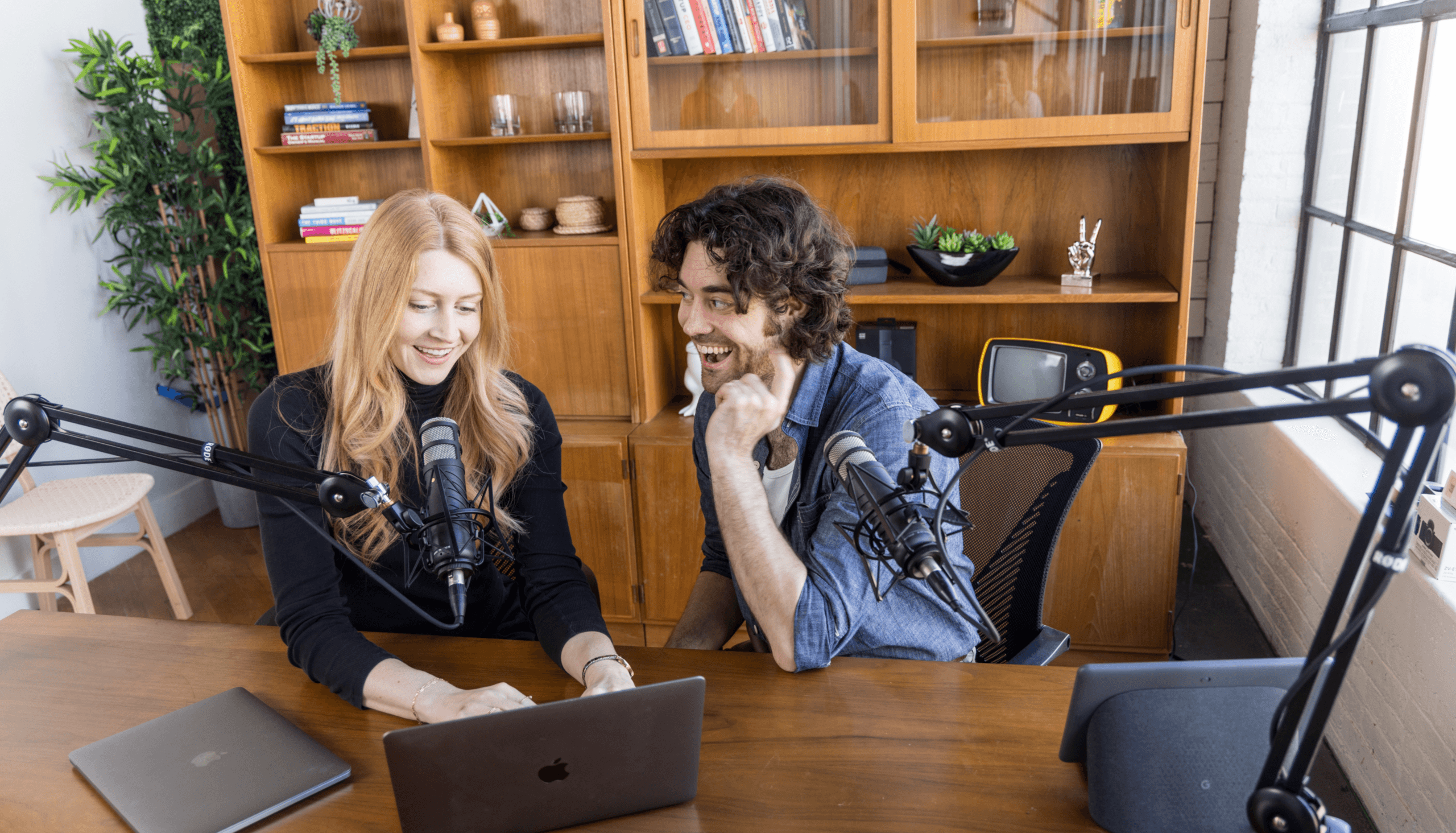
Why do AI buyers want to hear from your researchers?
New technology brings hope and questions in equal measure. Buyers want to know what’s real, what’s tested, and what happens when a model gets something wrong.
A specific answer goes a long way. When your researcher explains what a model does well, where it struggles, and how you check it, listeners can judge for themselves.
Being open about limits can make a show more credible. It’s the same thinking behind our b2b podcast production, tuned for a buyer who reads the fine print.
Who’s listening to an AI show?
You don’t need to serve every group at once. Choose the group you’d most like to win over first.
| Listener | What they want from an episode |
|---|---|
| Business leaders | A straight answer on what AI can do for their company this year. |
| Technical teams | Your architecture, your tradeoffs, and the reasoning behind both. |
| Procurement, legal, and risk | How you handle data, safety reviews, and accountability. |
| Researchers and engineers | A feel for whether your team shares their curiosity. It’s a quiet recruiting channel. |
| Journalists and analysts | Clear explainers and a thoughtful voice they can quote. |
Show formats for an AI audience
Six formats that suit AI teams
Start with one or two. You’ll know which ones land after a few episodes.
- The explainer. Each episode unpacks a single idea, such as model training or why “hallucination” happens.
- The builder’s conversation. An engineer walks through a recent decision and why they made it.
- The customer in practice. A customer shares how they use your product, including what they had to rework.
- The responsible AI discussion. Your team covers testing, oversight, and the risk questions customers raise.
- The skeptic’s seat. A guest pushes back on a premise and your team responds. It’s candid and memorable.
- The career conversation. Employees share how they found their way into AI work. Recruiters like these.
How do you keep accuracy and safety claims right?
Accuracy figures, rival comparisons, and safety statements all need checking. A producer can’t judge them, so your technical and legal reviewers do.
Before recording
- We’ll agree with you on off-limit topics first.
- Every guest gets briefed on those limits ahead of time.
- Unreleased work stays out of the audio unless your leadership signs off.
After recording
- Reviewers get timestamped access to the draft.
- Our editors cut and adjust from their notes.
- An episode ships only when your approver says yes.
Making AI explainers calm and easy to follow
The best AI explainers define their terms and skip the breathless predictions. Here’s how we help your speakers get there.
Outsider questions in prep
Producers prepare each speaker with the questions a thoughtful outsider would ask. They’ll point out jargon that needs a quick definition.
An analogy for the hard part
Tricky ideas like embeddings or fine-tuning land better with a good comparison. We’ll help find one that’s accurate.
Room to say “we’re not sure”
We ask guests where they’re least certain. A researcher who admits a puzzle often gives the clip people share.
Will the show go stale when the next model drops?
Build on lasting questions
AI news moves fast, and a show tied to each release ages in a week. Lasting questions keep the library useful.
- How to evaluate an AI tool.
- What to ask a vendor about data handling.
- How to roll out AI across a team.
- What responsible use looks like day to day.
Add timely episodes lightly
A short topical episode now and then keeps the feed current. Let the lasting ones carry most of the season.
- Show notes can link to papers, docs, and demos an episode mentions.
- For technical listeners, those links are often the most valued part.
- Clips with captions help people find the show, and the full audio goes along on a commute.
AI company podcast production services
Use the whole set or pick the pieces your team needs.
| Service | What it covers |
|---|---|
| Podcast launch services | Planning, naming, artwork, a trailer, and distribution, usually within 8 to 12 weeks. |
| Podcast production services | Audio recording and mixing so every episode sounds clean on any speaker. |
| Podcast editing services | Editing by ear keeps speakers sounding natural, with turnaround usually 3 to 5 business days. |
| Video podcast production | Captioned clips for LinkedIn and the channels your buyers scroll. |
| Podcast management | A producer keeps recordings on the calendar around launches and travel. |
| Podcast marketing services | Show notes and transcripts with links to your research and docs. |
| Podcast hosting for business | An open feed for the market, plus a closed one for customers or partners. |
| Narrative podcast production | A story-driven season with narration and music, quoted after a short call. |
What does a first season look like?
A first run of six to eight episodes gives you room to test formats. Here’s a simple way to plan those episodes.
Open with your founder
A short welcome from your founder or chief scientist on why the show exists and who it’s for.
Mix the formats
Rotate explainers, a builder’s conversation, and a responsible AI discussion so the feed has range.
Watch what people ask
Track listens, buyer replies, and mentions on sales calls. The topics people bring up afterward tell you what to make next.
What a podcast won’t do for an AI company
A show won’t improve your model, and it can’t stand in for documentation or support. Where it shines is showing people how your team reasons through hard problems.
It also relies on a few people who explain things clearly. If your strongest researchers are shy on mic, a host can carry the conversation while they add the depth.
Good audio alone won’t build an audience either. Discovery takes a plan tied to real goals like pipeline, partnerships, and hiring, and we’ll help you build one.
AI company podcast FAQs
Can we talk about unreleased work?
Your leadership and legal teams decide. We’d suggest keeping unreleased details out of the audio, and our podcast production process builds in review before anything ships.
Can we invite critics on the show?
Yes, if your team’s comfortable with it. A respectful skeptic tends to make a stronger episode, and we’ll help you prep for the tough questions.
Do you book guests?
Guests come through your own network, and we’ll make that easy. Our producers draft the outreach, brief each guest, and write the questions as part of our podcast management services.
Can the show be fully private?
Yes. Private podcast hosting opens a feed only to the customers or partners you invite. Keep in mind that anyone who hears audio can record it.
Why a separate page for AI companies?
AI companies face sharper questions about trust, testing, and hype. This page is built around those, while our b2b podcast agency page covers software shows more broadly.
What would it cost?
Your number depends on how often you publish and which extras you add. Try our podcast cost calculator to get a rough figure, and we’ll firm it up with you on a call.
Looking for another industry?
Start with the question buyers ask most
Tell us what prospects keep asking your team. On a short call, we’ll say whether a show fits and sketch the first few episodes.