


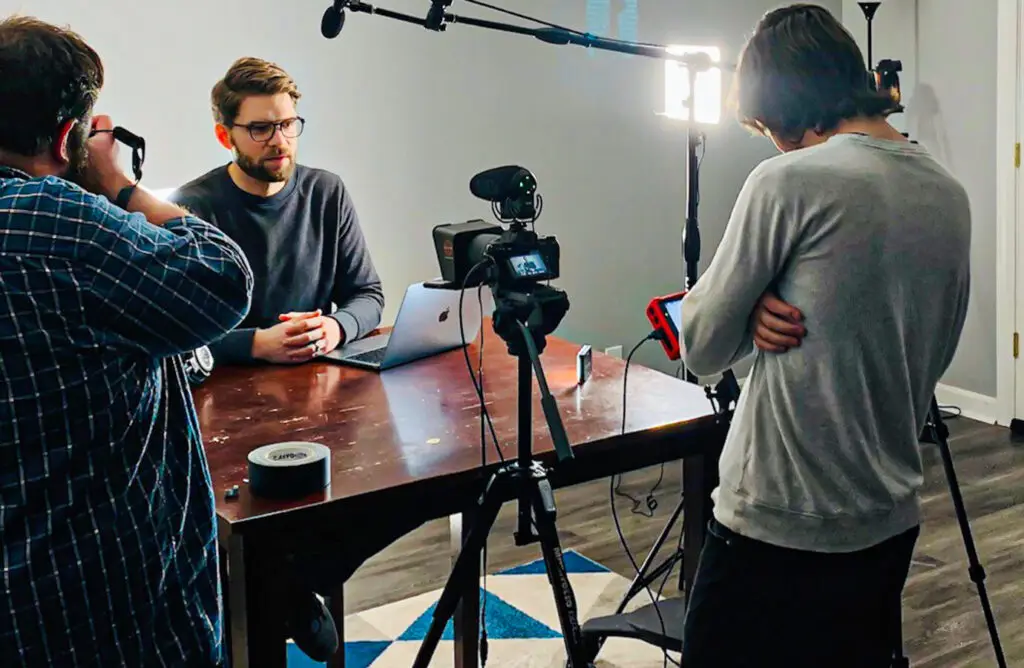


Full-service is a loose phrase, and two proposals can use it to describe different work. We write those proposals ourselves at Resonate Recordings, and we’d rather you know what to ask. Below you’ll find a nine-part checklist, the usual exclusions and a way to compare any two proposals side by side.
Full-service means different things
Two agencies can both say full-service and send quotes you can’t compare. One includes guest booking and the other doesn’t. One includes video, and the other treats it as an add-on.
The label tells you little, and the list tells you everything. A March 2026 Content Allies guide prices an outsourced agency at $2,000 to $20,000 or more a month. Its cost tables split the work into separate lines for producers, audio editors, show notes and graphics.
Those lines add up fast, and providers bundle them differently. Here’s a checklist of nine components you can hold any proposal against. Each part is included, billed separately or left out, and your job is to find out which.
The nine components
| Component | What it covers | Ask the provider |
| 1. Strategy and positioning | Goal, audience, format and pillars | Is this a workshop or a document? |
| 2. Creative assets | Cover art, music and a trailer | Who owns the files? |
| 3. Recording support | A producer on the session, remote or in studio | Is a producer present for every recording? |
| 4. Audio editing | Cleanup, levels and a final quality check | How many revision rounds? |
| 5. Video editing | Cuts, captions and formats | Is video in the base fee? |
| 6. Distribution setup | Hosting, directories and the RSS feed | Who owns the feed? |
| 7. Repurposing | Clips, summaries and posts | How many clips per episode? |
| 8. Guest coordination | Invitations, scheduling and reminders | Is sourcing included, or only scheduling? |
| 9. Analytics and reporting | Monthly numbers and a quarterly review | What does the review include? |
Few shows need all nine from day one. A small show might start with four core parts and add the rest, as we cover below. The point is to know what you’re buying before you sign.
What the first four cover
Strategy comes first, because everything else depends on it. A good provider asks about your goal, your audience and your format before touching a microphone.
Want to see what the document should contain? Our guide on podcast content strategy shows you.
Creative assets give your show an identity: cover art, music and a trailer. Ask who owns them if you leave. Recording support means a producer watches audio and timing, so you don’t discover a problem in the edit.
Audio editing is the biggest line for most shows, and editing time adds up fast.
A Castos cost guide puts outsourced editing at $50 to $200 an episode for freelancers, and $400 to $1,000 or more for full production. Ask how many revisions are included.
What the last five cover
Video editing is where scope often splits. Some providers include a basic cut and charge extra for captions or multiple formats. Ask for the exact deliverables.
Distribution setup covers hosting, directory submission and your RSS feed. The key question is ownership. We’re firm on this one: you own your feed from day one, and the contract should say so.
Repurposing turns each episode into clips and posts. Guest coordination covers invitations and scheduling, and sometimes sourcing. Analytics and reporting should end in a recommendation, with a chart as support.
We review results every quarter, so ask any provider what their review covers. Curious about the order of work? See our guide to how long a launch takes.
Sample deliverables to ask for
Numbers beat adjectives. If a provider says the package includes clips, ask how many, how long and in which formats. Then get these in writing:
- Episodes per month and the length of each.
- Clips per episode, with length and caption style.
- Revision rounds for audio and for video.
- Days from recording to a first draft.
- Format and date of each report.
- Hours of your own time the provider expects each month.
Put the answers in the contract. Then you can check delivery against a plain list, and the provider can show it kept its word. Disputes shrink when the list is clear.
Which parts to start with
On a tight budget, you don’t need all nine at once. Start with strategy, recording support, audio editing and distribution. Those four make a show that sounds right and reaches directories.
Add repurposing next, because it extends reach for little extra work. Video is a bigger choice with its own costs, which our guide on audio only versus video lays out.
Guest coordination and reporting can wait until the show has a steady rhythm. By month three, you’ll know which tasks you can’t keep doing alone. Let that decide your second round of purchases, not the brochure.
Keep a simple scorecard too. Each month, mark whether the provider delivered every item you agreed on, on the date you agreed.
Three misses in a row is a pattern worth raising. Raise it early and in writing, so the fix is a process change, not an argument.
Review the list at every contract renewal. A part you needed at launch may no longer matter, and a part you skipped may now be what slows you down. Treat scope as a living document.
What is usually left out
Even at the top tier, some costs sit outside the fee. Paid promotion is the biggest one.
Content Allies budgets LinkedIn promotion, paid social and ad placements separately from production. Treat that as a pattern, and confirm it with each provider. Common extras:
- Paid ad spend, which goes to the platform.
- Guest honorariums, if you choose to pay guests.
- Translation or dubbing.
- Event travel and on site recording.
- Legal review of guest releases.
That list reflects how we scope our own work, and other firms differ. Ask for exclusions in writing, because a missing item turns into a surprise bill later.
The unbundling check
Can you save money by buying each part separately? Sometimes. Often the saving disappears into coordination.
Every vendor you add is another contract, another contact and another handoff. Someone on your team becomes the project manager, and that time has a cost.
Run the check in three steps:
- Price each of the nine parts from separate sources.
- Add a rough value for your time spent managing them.
- Compare the total with a bundled quote.
If the gap is small, bundling usually wins on risk.
Content Allies puts outsourced full service at about $2,000 to $20,000 or more a month depending on scope, and in-house production at $1,000 to $8,000. Our cost page lists $2,100 to $6,500 a month.
Want the drivers behind those numbers? Our B2B podcast cost guide explains them.
Red flags in a full-service pitch
Some patterns should slow you down. Watch for a price with no deliverables, a promise of fast results with no timeline, and a contract that locks you in and keeps your files if you leave.
Watch for vague words too. Fully managed, white glove and all inclusive describe a feeling, but a scope needs numbers. Ask the salesperson to turn each phrase into a number or a task.
Also ask who will do the work. In some agencies the senior person sells and a junior team delivers, which can be fine if the process is strong. Ask to meet your producer and editor before you sign, and ask what happens if either one leaves.
Ask for a reference from a client with a similar goal, too. A good provider will connect you, so if you only hear about big brands, ask how they treat smaller shows.
How to read a proposal
Lay the proposal next to the table. Mark each component as included, extra or missing. Then ask three questions:
- What exactly is included in each line, in deliverables and numbers?
- What is billed separately, and at what rate?
- How are changes handled in the middle of the contract?
A clear proposal answers all three without effort. A vague one says all inclusive and fully managed with no list. If a provider won’t give a deliverables list, take that as your answer.
Also check the term and the exit. Plan for a year, since we recommend at least six months and ideally twelve. Ask what you get at the end: raw files, the feed and your assets.
Want a longer set of prompts? See our guide to vetting an agency.
Video, clips and music rights
Three items cause most scope fights: video, short clips and music. A Vidpros guide says video edits often cost extra, from $40 to $300 or more per video. It also says native vertical short clips (it cites 8 to 12) are priced separately, per clip.
If video matters, treat it as its own line. Ask for the number of cuts, the formats and the caption style in writing. A quote that says video included with no counts isn’t really a quote.
Music is the quiet one. Custom music is often licensed to you, not owned by you, so you may have to drop the theme if you leave. Ask which it is before you fall in love with the intro.
Check these three lines first in any proposal. Vidpros sells video editing, so weigh its framing, but the questions hold for any provider.
Contract and exit terms
Most cost guides stop at price, including the Castos and Content Allies ones. The missing contract terms are where deals go wrong.
Vidpros says most engagements run six or twelve months with 90 days of notice, and it writes a 30 day handover into its own contracts. We’d ask for a handover clause in any agency contract. Settle these four terms:
- Who owns the raw recordings and final audio.
- Who owns the RSS feed and the cover art.
- Who owns the music, or whether it is only licensed.
- How much notice you must give, and what the handover includes.
Also check episode caps. Packages are often priced monthly with a cap that’s easy to miss, and it matters when a launch month needs extra episodes.
Think of the contract as part of the scope. If it isn’t in writing, you can’t count on it, whether that’s a studio session, a monthly report or any other line.
What we can’t tell you
We can’t give you a single price for each component, because rates vary too much by provider, scope and show format.
What we can offer is the checklist: use the nine parts, ask the three questions and compare totals including your time. Want a partner to scope it? Our podcast production services cover the production side.
Choosing between doing it yourself and hiring out? Read our guide on when to hire an agency.
Conclusion
Full-service is a promise, and the list is the proof. Use the nine parts to see what’s in, what’s extra and what’s missing, and ask for deliverables, exclusions and exit terms in writing.
Have a proposal in hand? Book a call and we’ll go through it with you.