


Everyone asks about video.
I understand why. Every platform is pushing it. The Content Club reported in June 2026 that 75% of weekly podcast listeners now prefer a video component. Some guides are calling the audio-versus-video debate settled. I manage production for a podcast production agency that has worked on more than 3,000 shows. The debate is not settled. It is just louder. And the noise is causing B2B marketing teams to make format decisions they are not operationally ready to execute.
This post is the cost breakdown we share with every client who asks the question. Real numbers. Real post-production hours. And the three questions that tell us more about which format is right than budget or audience size ever does.
Our production team has worked on more than 3,000 shows since 2014. We have seen audio-only shows outperform video shows with twice the budget, and video investments pay off when the infrastructure was in place before episode one. The observations below come from that volume of production.
What the Market Is Saying (and What It Is Missing)
The video push is real
The push for video comes from real data. YouTube has passed 1 billion monthly viewers of podcast content. Spotify reports more than 240 million users have streamed a video podcast. The Podcast Marketing Academy and Lower Street’s 2025 Cost of Attention Report found that 78% of listeners who discovered a show on YouTube still consume it through the audio feed. YouTube was what brought them in. Video is a discovery channel. That part is accurate.
What those headlines skip is the production reality. The same report found that adding video increases cost per hour of audience attention by 77% and triples post-production time per episode. The Podcast Consultant, which produces exclusively for B2B finance companies, puts total per-episode production at 12 to 20 hours once a show is running. Most executives are surprised by that number. They had been told podcasting was a low-effort channel.
What the audio data still shows
The Reuters Institute 2025 Digital News Report found that 73% of news podcast listeners say audio helps them understand issues more deeply than any other medium. The Fame 2025 B2B Podcasting Trends Report put audio episode completion at 80% or higher versus 12% for video. These numbers do not mean video is wrong. They mean the format decision is a production decision before it is a marketing one. We covered the strategy layer separately in our piece on what actually matters in B2B podcasting in 2026. This post is about cost.
The Three Decision Questions (The Video Readiness Framework)
Before we recommend a format, we ask three questions. These tell us more than budget or audience size.
Question 1: Do you have a YouTube strategy, or just a YouTube channel?
A YouTube channel is a destination. A YouTube strategy means you have researched what your target buyers search for on that platform. You have built a publishing calendar around those terms and committed to the first 90 to 180 days before the algorithm starts recommending your content. Most B2B teams have the channel. Few have the strategy.
Shows that launch video without this groundwork typically plateau at 50 to 100 views per episode. That is not a YouTube presence. It is a YouTube graveyard with a production invoice attached.
Question 2: Can your team commit 10 to 16 post-production hours per episode?
Audio editing for a one-hour interview takes two to four hours of engineer time. Adding video sync, color correction, lower thirds, clip production, and multi-platform export adds another six to twelve hours. If your team cannot sustain that load, video production breaks cadence within six months. Social Peak Media put it directly: choosing a production format that exceeds your actual capacity is how B2B podcasts stall.
We see it constantly. The show launches with video, the backlog builds, and by episode 10 the team is publishing late or dropping video entirely.
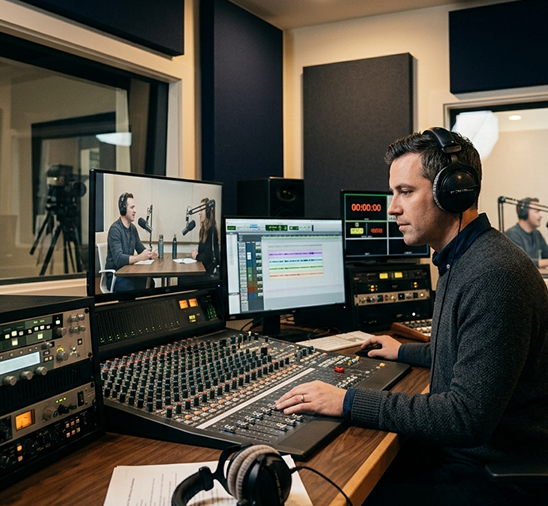
When a new client asks about adding video, the first thing I tell them is that they are not just turning on a camera. They are adding an entirely new production workflow. With audio, we are focused on making you sound great. With video, we are also managing lighting, framing, camera settings, file management, editing multiple angles, graphics, captions, and platform-specific exports. The biggest surprise is almost always the amount of content that comes after the recording ends. Larger files, longer edit times, more review rounds. None of that is a reason to avoid video. It is just something you should plan for from the beginning.
Question 3: Has your host built on-camera presence?
Audio rewards expertise. Video rewards eye contact, body language, and practiced screen confidence. A guest who is compelling in conversation can read as hesitant or distracted on camera. That perception transfers directly to brand credibility. On-camera coaching is a real production cost that almost no B2B show budgets for upfront.
What Each Format Actually Costs
Most cost guides give ranges wide enough to be useless. These are the tiers we work in, based on managed production, not DIY. The post-production hours column is the one most clients do not see coming.
| Format | Production Scope | Monthly Range | Post-Prod Hrs/Ep |
|---|---|---|---|
| Audio-only, Essential | Edit, mix, master, show notes, distribution | $500 to $1,200 | 2 to 4 hrs |
| Audio-only, Full-Service | + Music, sound design, transcript, dedicated producer | $2,500 to $5,000 | 4 to 6 hrs |
| Audio and Video, Essential | Audio production + basic YouTube video edit | $1,200 to $2,800 | 6 to 8 hrs |
| Audio and Video, Full-Service | + Multi-angle, social clips, producer, YouTube strategy | $5,500 to $10,000+ | 10 to 16 hrs |
Which Format Is Right for Your Show
The cost table above answers what each format costs. This table answers when each format makes sense.
| Format | Best for | Consider carefully if… | Verdict |
|---|---|---|---|
| Audio-only, full-service | Interview shows, high-cadence publishing, remote guests, new shows in their first 12 episodes | Your buyers primarily discover new content on YouTube and your host has built on-camera presence | Lower cost, higher completion rates, faster to sustain at any publishing cadence |
| Audio and video, full-service | Shows with a defined YouTube strategy, visual products, hosts with screen presence | You lack 10 or more post-production hours per episode or a defined clip distribution workflow | Premium reach with 2 to 3x the production cost and editorial overhead |
| Video-first launch | Shows where video is a core sales activation tool and guests record in controlled environments | Your guests record remotely from uncontrolled setups or your show is unproven on any format | High upside, high failure rate without production infrastructure in place before episode one |
The Hidden Costs Most Proposals Miss
The tiers above cover production. They do not cover the costs that make video decisions expensive in ways teams do not anticipate.
Recording environment
A remote audio interview needs a decent microphone and a quiet room. A remote video interview needs that, plus camera, lighting, a clean background, and a host who knows what to do with the frame. When guests are recording from their own offices, you are depending on them to get setup right.
Every one of our full-service clients starts with a tech consult before they ever record an episode. We walk through their equipment, camera setup, lighting, framing, audio, recording environment, and recording platform so they are set up for success from day one. For clients who want an extra layer of support, we also offer remote recording assistance. One of our engineers joins before the session begins to check cameras, microphones, internet stability, lighting, and framing. The most common issue we see is lighting. Modern cameras are remarkably capable, but poor lighting can make even the best camera look mediocre. A simple adjustment, like turning toward a window or repositioning a light, can make a significant difference.
Social clip production
B2B teams often assume video automatically produces social content. It does not. Clips require their own edit pass: identifying the moment, cutting for vertical formats, adding captions, exporting per platform. Professional short-form clip production runs $75 to $200 per clip. At three clips per episode and four episodes per month, that is $900 to $2,400 in clip production alone. See our full breakdown of podcast video production services for what is included at each tier.
On-camera presence
Audio rewards expertise. Video rewards eye contact, body language, and the confidence that comes from being practiced on screen. A guest who is compelling on audio can read as nervous or disengaged on camera, and that is what your audience sees.
The most common habit I coach people out of is paying too much attention to themselves instead of the conversation. When people can see themselves on screen, they start worrying about how they look instead of focusing on their guest. The best podcast interviews happen when you forget the camera is there. If you are genuinely listening to your guest, you will come across as more confident and much easier to watch. You are not trying to be a television presenter. You are having a conversation.
When Audio-Only Is the Right Call
Audio-only is not a compromise. For most B2B shows, it is the better strategic decision.
The conditions where we recommend audio-first
Your audience listens on the go. Audio delivers 80% or higher episode completion rates. Video averages 12% (Fame, 2025). Audio holds attention where video cannot. Your show is interview-driven with rotating remote guests. Consistent video quality across external guests is operationally expensive and difficult to enforce. You are launching.Prove the show works before adding production complexity. Your host has not built on-camera presence yet. You are publishing more than four episodes per month.
The Podcast Marketing Academy and Lower Street report found that in shows producing both formats, 78% of all listening time still happened through the audio feed. Video drove discovery. Audio retained attention. For B2B shows where depth of engagement matters more than raw reach, audio remains the higher-efficiency format.
We have definitely had conversations where a client came in convinced they needed a full video podcast because everyone is doing video. Our first question is always: why? If the answer is simply that they want social clips, a full multi-camera video podcast may not be the best use of their time or budget. Video adds another layer of production, and if a team is not prepared for that commitment, it can quickly become the thing that causes missed recording dates or inconsistent publishing. Our job is not to sell clients the biggest production package. It is to help them build a show they can sustain. I would rather see a client publish consistently with a format that fits their goals than overcommit to video and struggle to keep the show going six months later.
When Video Is Worth Every Dollar
Video earns its premium when specific conditions are met. Half-hearted video is not a cost-saving strategy. A poorly lit talking-head video on a YouTube channel with 80 subscribers does more damage to brand perception than no video at all.
The conditions where video investment makes sense
Your show has a defined YouTube strategy, not just a channel. YouTube is a search engine. Shows that break through have done keyword research, built a publishing calendar, and committed to the first 90 to 180 days before the algorithm recommends their content. Your host is natural on camera and willing to invest in setup and coaching. You have the bandwidth to produce clips consistently. Video without clips leaves the majority of discovery value unused. You are targeting a younger or more visual professional audience. 45% of people who tried a new podcast in the past six months found it on YouTube (Heart Centered Podcasting, March 2026). For Gen Z professionals, that discovery rate reaches 84% (Sweet Fish Media, 2025). Your show is already working on audio.
The teams that succeed with video are not the ones with the most expensive equipment. They are the ones with a workflow that lets them produce consistently without every episode feeling like a scramble.
What This Guide Skips and Why
Every cost breakdown involves scope choices. Here are three approaches we deliberately left out.
The Talking-Head Trap
A raw talking-head video, two people on a split screen with no editing beyond cuts and no motion graphics, is recommended in some guides as a low-cost video entry point. We do not recommend it for B2B shows. A poorly produced talking-head video signals that the brand did not invest in the medium. It is not cheaper than audio. It is cheaper than good video, and that gap is visible. If budget is the real constraint, audio-only at the full-service tier produces stronger brand perception than low-effort video.
The Launch-with-Video Mistake
Some teams commit to video before the show has proven itself. They invest in studio setup, equipment, and production infrastructure for a show that does not yet have an audience or a stable format. We recommend launching on audio, running 12 to 20 episodes, then adding video to a show that knows what it is. The exception is when video is part of an explicit sales activation strategy where ROI does not depend on audience size.
The Clips-Will-Happen Assumption
The assumption that video production automatically produces social content is the most common planning failure we see. Clips do not happen automatically. They require dedicated editorial time, a clear brief, and a distribution workflow. The clip budget needs to be in the original production plan, not treated as an afterthought.
What Producers Notice About This Decision
The completion rate gap is about context, not preference.
Audio commands 80% or higher episode completion. Video averages 12%. The gap is not because people prefer audio over video. It is because audio can be consumed in contexts where video cannot. Your B2B buyer is listening on a commute, during a workout, or between meetings. They are not watching a talking-head interview on a laptop at the same time. Understanding this changes how you think about video. It is not a replacement for audio in B2B. It is a different consumption mode serving a different moment.
Video drives discovery. Audio holds attention. These are not the same job.
The most useful finding from the 2025 Podcast Marketing Academy report was not the 77% cost increase. It was this: 78% of listening time on shows that produce both formats still happened through the audio feed. Video brought new people in. Audio kept them. If your goal is depth of engagement with B2B buyers, audio holds 45 minutes of attention where video cannot. That is the counterintuitive truth the current video push glosses over.
We cannot tell you whether your audience will watch video. We can tell you the production cost of finding out. The more defensible path is to prove audio first, then add video to a show that already knows its audience.
The format that works is the one you can sustain.
The strongest B2B shows on our roster are built on a clear editorial premise and a production workflow that matches their actual capacity. We have seen audio-only shows on our full-service podcast production roster outperform video shows with twice the budget because the audio team published every week without slipping. Consistency beats format every time. See our breakdown of what a B2B podcast launch actually involves for the patterns that hold.
The Format Decision Is a Production Decision
Most conversations about audio versus video stay at the marketing level: reach, discovery, platform strategy. Those are real considerations. But the decision that determines whether video succeeds for a B2B show is a production decision. Do you have the post-production hours, the clip workflow, the on-camera talent, and the YouTube strategy to sustain it?
The market pressure toward video is real. But pressure and readiness are two different things. The shows on our roster that have built genuine YouTube audiences did not get there by deciding to do video. They got there by building the infrastructure to do it consistently, and by starting with audio until they knew what their show was.
Book a call with our team and we can walk through the format decision based on your specific goals, your publishing cadence, and your team’s actual bandwidth.
Strategy-first. Production second. Growth always.