


Your completion rate lies.
Not deliberately. It is measuring exactly what it was built to measure, which is whether a person clicked through a module. The trouble is that everyone treats that as a proxy for learning, and there is now good evidence it is not.
Researchers at UC San Diego tracked 19,500 staff for eight months. They found no real link between finishing the mandatory annual security course and actually resisting a phishing email. Three quarters of people spent a minute or less on the training material. A third closed it immediately.
That is a phishing study, and the shape of it will feel familiar to anyone who has run compliance training. So the question is not whether your LMS is working. It is what job it can reasonably do, and what job needs a different tool.
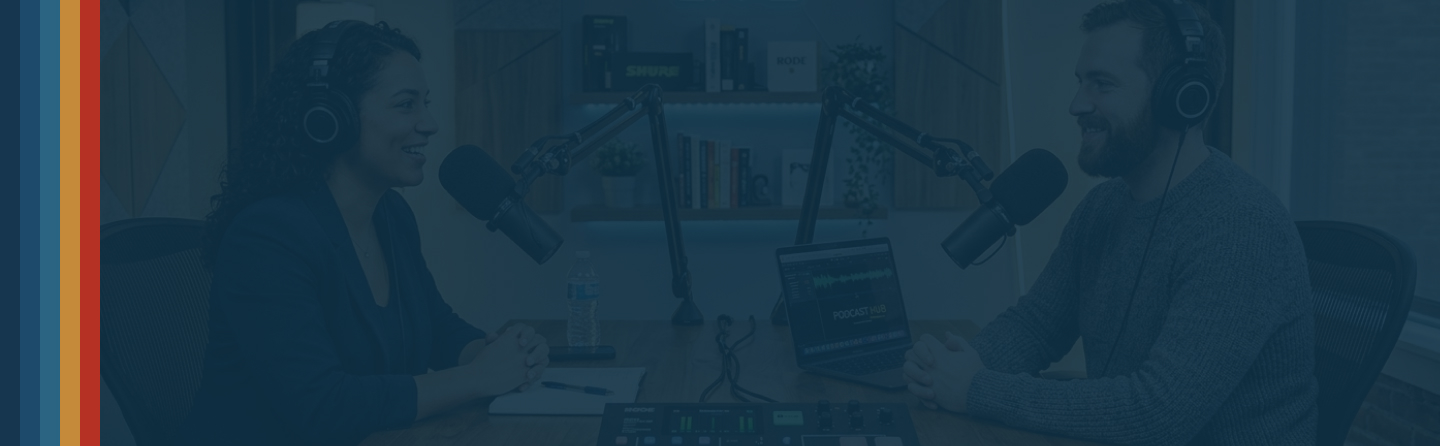
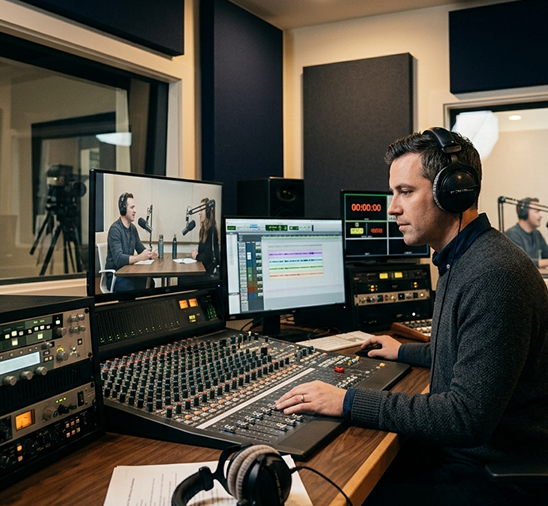
I work at a podcast production agency that builds internal shows, so you can guess which tool I like. What follows is the honest version, including the parts where audio is the wrong answer.
The learning claims below come from peer-reviewed research, named and dated. If a popular L&D statistic could not be traced to a real study, I leave it out and say why.
What the Research Says Audio Is Good For
Start here, because it decides everything downstream. And start by throwing out the argument you have probably been sold. Why does audio work at all?
Not Because Anyone Is an Auditory Learner
The idea that matching a lesson to someone’s preferred sense improves results is called the meshing hypothesis. Pashler, McDaniel, Rohrer and Bjork reviewed it in 2009 in Psychological Science in the Public Interest and found no sound evidence base for it. Several well-designed studies went the other way.
People do have preferences. Teaching to those preferences does not raise outcomes. If a vendor opens with auditory learners, you have learned something useful about the rest of their deck.
Listening Matches Reading, Until Reasoning Starts
The best evidence is a 2022 meta-analysis by Virginia Clinton-Lisell in Review of Educational Research, pooling 46 studies and 4,687 participants.
Overall, reading and listening came out level. For grasping a fact stated outright, they matched exactly. For reasoning across a passage and drawing a conclusion, reading won by a clear margin.
That is a design brief. Audio carries stated information as well as text does. It degrades the more someone has to piece an answer together across sections.
Long Audio Overloads People
Speech is fleeting, vanishing as the next words replace it, while text sits still and can be read twice.
Wong, Leahy, Marcus and Sweller showed the consequence in Learning and Instruction in 2012. Audio beats visual presentation over short stretches, and that advantage shrinks or reverses as the stretch grows, because sustained speech floods working memory.
This is why a 52-minute recorded town hall performs so badly, and why our internal shows run eight to fifteen minutes.
A Weekly Show Spaces Itself
Here is the strongest argument available, and almost nobody makes it.
Distributed practice, better known as spacing, is one of the best-replicated findings in learning research. Cepeda, Pashler and colleagues pooled 839 results from 317 studies in 2006. Spread exposure out and it sticks better than cramming, and the right gap grows with how long you need it to last.
A weekly internal show is a spaced schedule nobody had to design. An annual compliance module is cramming with a twelve-month gap.
One caveat, and it is a design instruction. Spacing only pays when the same ground returns. A series where every episode is brand new is serial, not spaced. Plan recurring themes on purpose or you give the benefit away.
The Split: What Goes Where
Put those four findings together and the division of labour writes itself.
| Content type | Goes in | Why |
| Why a policy exists | Podcast | Context and reasoning. Hard to write, easy to say. |
| How to run the process | LMS or doc | Steps must be re-readable and followed in order. |
| What changed this quarter and why | Podcast | Narrative, time-bound, benefits from a human voice. |
| Reference tables and thresholds | LMS or doc | Look-up material. Must be exact and searchable. |
| How a senior person thinks about a call | Podcast | Judgment transfers best in speech. |
| Anything you assess or audit | LMS | You need a defensible record and a score. |
| Customer or incident stories | Podcast | Story is what makes the lesson stick. |
| Anything with a number they must get right | LMS or doc | Fleeting audio is the worst possible carrier. |
Notice that nothing in the left column argues for replacing your LMS. The podcast takes work the LMS was always bad at, and leaves the record-keeping where it belongs.
Once an onboarding series works, the same feed can carry leadership updates and policy context for everyone. That wider show is an internal communications podcast, and onboarding is a good first season for it.
Onboarding Is the Best Place to Start
If you only run one internal show, make it the onboarding one. Three reasons.
The content is repeatable. A new starter in March needs what a new starter in September needs, so you build it once and it runs for years. Very little internal content has that property.
The audience renews constantly, which means your listener list is never stale and the show never runs out of people who have not heard episode one.
And the cost of failure is measurable. In healthcare, the 2026 NSI retention report covering 527 hospitals puts the cost of replacing one bedside nurse at $60,090, with 22.7 percent of new hires gone inside a year. You do not need a big effect to justify the show at those numbers. The costs in other industries are set out in internal podcasts by industry.
A working shape: eight to twelve episodes of ten minutes each, released over a new starter’s first 90 days. Cover the things people actually ask in their first month, not the things the handbook covers. If your Slack has a channel where new joiners ask questions, your episode list is already written.
A finite series also dodges a common failure. Resonate’s guide to how long podcast ROI takes lists no one internally owning consistency among the reasons a show falls short. An onboarding series of eight to twelve episodes has an end date, so nobody has to promise to keep it going forever.
Keep the Voice Human
Onboarding audio has one job beyond information. It helps a new starter feel they know the people they work for.
That job fails when the edit sounds processed. A voice with every pause trimmed and every breath gated out sounds like a recorded announcement. People tune out announcements.
Jessica Ramsey, who works in production at Resonate, gives every editor who joins the team a test edit. It shows technical skill. It also shows how heavily an editor leans on automated processing. In a recent batch, several test edits had a very small dynamic range. The interviews sounded quiet and flat, as if the conversation happened in a closed room. Nothing was wrong with the recordings. They just did not sound like people talking.
Her rule applies to a training series too: clean audio is not the same as natural audio. An AI tool can help an editor decide faster. A person still has to decide what stays.
Before you release a series, run her 60-second test on your first episode. Listen on headphones. Do the pauses sound human? Does the room go silent between words? Does the speaker still sound like themselves? A new starter will hear a leader’s voice for ten minutes at a time, so the voice matters more than the polish.
Video is a separate decision. Resonate’s guide to when YouTube is worth the production cost puts video editing at two to three times the time of audio, so it should earn its place.
Can Your LMS Track It? Mostly No
Every L&D team asks this within about ten minutes, and the honest answer has three layers.
What Breaks If You Upload Audio
Most platforms treat audio as a file attachment, or as video with the picture missing. Upload an MP3 and it often gets handled as a video object, which tends to work on desktop and fail in the mobile app.
The common workaround, documented in practitioner forums, is converting the audio to an MP4 with a still image so the system will count it. Call this the MP4 Costume. You dress audio as video so a database will admit it exists.
The alternative is hosting elsewhere and embedding a player, which plays fine and records no completion at all.
Both choices destroy the thing that made a podcast useful. Once someone must sit in a browser to earn credit, you have rebuilt e-learning with worse ergonomics.
SCORM Cannot Reach a Podcast App, By Design
This is architectural, and nobody will patch it.
SCORM runs inside a browser session. The LMS launches content in a browser window on the same domain, and the content reports back through a JavaScript object in the parent window. Nothing in that model can observe what happens inside a podcast app on a personal phone during a commute.
xAPI lifts the limit. Each record names an actor, a verb and an object, and travels over HTTP to a Learning Record Store from anywhere. “Completed episode three” is exactly what it exists to hold.
The Honest Limit on Proving a Listen
Here is the part vendors skip. xAPI does not watch anyone listen. Something in the chain has to send that record.
If a person listens through a plain private feed in their own podcast app, all you can claim is a download or stream event on your server. That is proof a file moved. It is not proof a human listened, and it is certainly not proof they understood.
Real listening data needs one of three things. A host that emits xAPI records from its own logs. A player you have instrumented yourself. Or a separate check, such as a short quiz. All three are builds rather than settings.
There is also still no published audio profile in the ADL registry, so teams that do this end up adapting the community video profile. Workable, but not a standard.
The Rule That Settles It
Keep the LMS as the official book of record, and use the podcast to make the content land.
If you need proof for an auditor, the proof is the assessment in the LMS. The podcast carries the reasons, the context and the repetition that help someone pass for real rather than by clicking through.
That split matches the research above exactly. Fixed, re-readable, reason-it-through material stays in the LMS. Fleeting, story-led, context-heavy material goes to audio. It is not a compromise. It is each medium doing what it does best.
How the private feed itself reaches people, and what it can and cannot report, is covered in what private podcast hosting is and how it works.
What to Measure Instead
If downloads are a weak signal and completions are a weak signal, what is left?
Finish rate is the first honest number. A listener who reaches the end of a ten-minute episode has given you ten minutes of attention, which is more than most LMS modules receive.
Repeat subscription is the second. People who come back for episode four have made a judgment about episodes one to three, and no survey will tell you that as reliably.
Uptake by team is the third, and it is the one that changes what you do next. Per-person feeds make it possible, because download data maps to an individual rather than a crowd. When one region is at 20 percent and the rest are at 70, you have found something worth a conversation.
What none of these do is prove learning. Nothing in internal comms measurement does, and be wary of any platform that says otherwise. The same measurement logic applies to public shows, which we worked through in how to measure what your show is worth.
Conclusion
Your LMS is not broken. It is being asked to do a job it was never built for.
It is a good system of record and a poor teacher. Completion data has stood in for learning for two decades, because it was the only number available.
A podcast will not fix that on its own. What it does is reach the people your LMS never reaches. It works in the format the research backs for context and judgment, on a rhythm that gives you spacing for free. Keep the record where it belongs, and let audio do the part it is actually good at.
Ready to build one? The private podcast hosting page sets out the delivery options.