

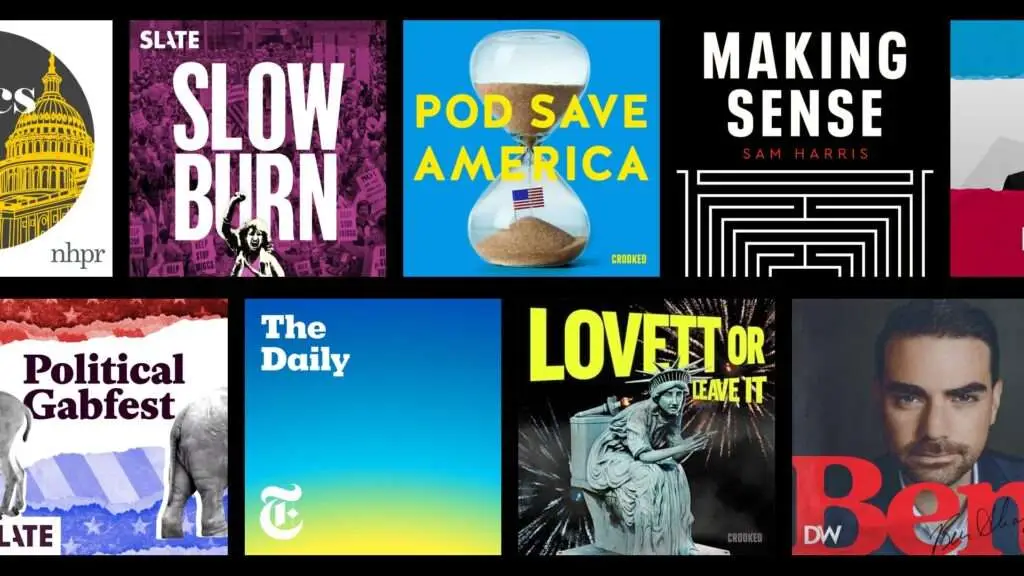


Most lists of political podcasts sort shows by party and stop there. As a full-service podcast production agency, we look at how shows are built, and the biggest difference is who is speaking.
So we sorted nine shows by role instead. Pick by how you like to listen, and use the table to compare lengths and schedules side by side.
How we built this list, and what we left out
Our entry rule was simple. A show needed a current Apple Podcasts page with fresh episodes in October 2026. For each one, we noted the publisher, hosts, episode count, rating and usual length.
We describe each show the way its own Apple page does, and we skip our own opinions about its politics. If the page names a movement or a background, we pass that along. If it doesn’t, we stay neutral.
We also paid attention to who is speaking on each show, because that predicts what you’ll hear better than anything else. It’s what shaped the groups below.
Reporters, advocates and strategists
Political shows differ less by party than by who’s doing the talking. We sort them into three roles:
- Reporters: A newsroom explains what happened and why it matters. The Daily and The NPR Politics Podcast sit here.
- Advocates: Hosts argue for a view, and often name their side. Pod Save America, The Bulwark Podcast, The Dispatch Podcast and The Megyn Kelly Show sit here, along with long conversation shows such as The Ezra Klein Show.
- Strategists: People who know campaigns from the inside explain how the game works. Hacks On Tap and The Rest Is Politics: US sit here, with campaign veterans from both parties, a former White House communications director and two veteran journalists among the voices.
The same story sounds different from each role. A reporter tells you the facts. An advocate tells you what to do about them, and a strategist tells you how it will play.
A balanced feed isn’t two opposing advocates shouting past each other. It has one voice from each role. If every show you follow argues a view, you’ll hear plenty of arguments and very few facts.
Political podcast rankings: why we don’t rank
Castos dates its politics list June 2023 under a 2026 title and gives no ranking method, and Riverside’s 2026-titled list was last updated in December 2025 yet still says “In 2024”. Vidpros says its shows were ranked by real data but never explains the weights. Its subscriber count for one host is 7.23 million in one place and about 6.6 million in another.
We wouldn’t trust a ranking with no method, so we don’t rank. These are groupings, not a leaderboard. Apple doesn’t publish listen counts, so nobody can name the most-listened-to political podcasts from Apple data. Ratings measure fan enthusiasm, not accuracy: a show with 106,000 ratings and a 4.3 isn’t worse than one with about 1,000 ratings and a 4.4. What we can check is activity, length, schedule and who produces each show, because those are on every Apple page.
That’s why the table shows lengths and schedules, so you can decide for yourself. If a list calls itself a ranking but shows no dates or method, treat it as a guess.
Political podcasts both sides: how to read a show’s slant
Castos mixes progressive, conservative and cross-spectrum shows and doesn’t assess balance. Vidpros sorts shows into liberal, conservative and unbiased, but doesn’t explain how it labeled them. Its unbiased group includes hosts with clear leanings.
We avoid labels we can’t back up. Instead, we report what each show says about itself on Apple, as the show’s own claim:
- Pod Save America says its hosts are former Obama aides.
- The Bulwark’s Apple page calls it the flagship podcast of the Never Trump movement.
- The Dispatch Podcast’s episode notes describe its coverage as nonpartisan.
- The Megyn Kelly Show bills itself as “no BS, no agenda and no fear.” Its Apple page doesn’t name a side, but Kelly is widely described as a conservative commentator.
The Daily and The NPR Politics Podcast come from newsrooms. If you’re looking for liberal or conservative shows by name, read the About text, then play one full episode. Pay attention to how a host handles a fact that hurts their side. That moment says more than any label.
If you only follow shows from one side, add a reporter show first. It’s the easiest way to check whether the arguments you hear line up with the facts.
The quick comparison
| Show | Role | Who makes it | Typical episode | Cadence on Apple |
| The Daily | Reporters | The New York Times | 23 to 42 minutes | Daily |
| The NPR Politics Podcast | Reporters | NPR, Tamara Keith and Miles Parks | 18 to 34 minutes | Weekdays |
| Pod Save America | Advocates | Crooked Media, former Obama aides | About 45 minutes to 1 hour 34 minutes | Tuesday, Friday and Sunday |
| The Ezra Klein Show | Advocates (conversation) | New York Times Opinion | About 1 hour to 1 hour 17 minutes | Weekly on Apple, often twice a week |
| The Bulwark Podcast (now The Bulwark Daily) | Advocates | The Bulwark, Tim Miller | 50 minutes to 1 hour 15 minutes | Weekdays |
| The Dispatch Podcast | Advocates | The Dispatch, Steve Hayes and guests | About 1 hour to 1 hour 20 minutes | Weekly |
| The Megyn Kelly Show | Advocates | SiriusXM, Megyn Kelly | Often close to 2 hours | Daily |
| The Rest Is Politics: US | Strategists | Goalhanger, Katty Kay and Anthony Scaramucci | About 20 to 47 minutes | Fridays or semiweekly |
| Hacks On Tap | Strategists | Vox Media, David Axelrod, Mike Murphy and John Heilemann | About 1 hour to 1 hour 15 minutes | Weekly |
Lengths and cadence come from Apple Podcasts in October 2026. Shows change schedules often, so check the page before you commit.
Reporters: news explained by newsrooms
1. The Daily
If you only have room for one news show, make it this one. The Daily is The New York Times’ news show, built around one major story told by the paper’s journalists, six days a week. Michael Barbaro, Rachel Abrams and Natalie Kitroeff host.
It has about 2,800 episodes and a 4.3 rating from more than 106,000 ratings. Recent episodes run roughly 25 to 45 minutes, even though the About text still says twenty minutes a day.
Best for: people who want one story explained well each morning. It doesn’t cover the full range of politics.
2. The NPR Politics Podcast
This is the quick, reported catch-up. NPR’s reporters explain news from Washington and the campaign trail every weekday, with a focus on why it matters. Tamara Keith and Miles Parks host.
It has about 2,000 episodes, a 4.4 rating from more than 25,000 ratings and a typical length of 18 to 34 minutes, which makes it the shortest regular listen here.
Best for: busy listeners who want a quick, reported update. There’s less room for long argument.
Advocates: hosts who argue a view
3. Pod Save America
Think of it as the week’s news from friends with strong opinions who want you to get involved. Hosts Jon Favreau, Jon Lovett, Dan Pfeiffer and Tommy Vietor are former Obama aides, and they speak from the left.
Crooked Media publishes it. There are about 1,600 episodes and a 4.5 rating from about 85,000 ratings. New episodes arrive Tuesday, Friday and Sunday and run from about 45 minutes to 1 hour 34 minutes.
Best for: listeners who share its progressive starting point and want to act on the news. It’s plainly a point-of-view show.
4. The Ezra Klein Show
You come here for one deep conversation per episode. Ezra Klein talks with guests about big public questions, from climate policy to markets to artificial intelligence. New York Times Opinion makes it, and Klein writes from a liberal perspective.
It has about 545 episodes and a 4.3 rating. Apple lists it as weekly, though recent episodes have arrived about twice a week, and they typically run about an hour.
Best for: listeners who like ideas and long talk. Politics is only one of its topics.
5. The Bulwark Podcast
Expect weekday news analysis, commentary and long interviews from a show whose Apple page calls it the flagship podcast of the Never Trump movement. Tim Miller hosts. Apple now lists the feed as The Bulwark Daily.
There are about 500 episodes and a 4.6 rating from more than 11,600 ratings. Full episodes run about 50 minutes to 1 hour 15 minutes.
Best for: listeners who want a daily show from the anti-Trump center-right.
6. The Dispatch Podcast
Expect a calm, long conversation about the week. Steve Hayes leads a discussion of politics, policy and culture with Jonah Goldberg, Megan McArdle and guests, from a center-right outlet that calls its coverage nonpartisan.
There are 682 episodes and a 4.6 rating from about 3,500 ratings. It updates weekly, with episodes of about an hour to 1 hour 20 minutes.
Best for: listeners who like a long, relaxed conversation from the center-right. It has a smaller audience than the biggest shows, so expect fewer reviews.
7. The Megyn Kelly Show
If you want a long daily conversation with a strong host, this is it. Megyn Kelly, a former Fox News and NBC anchor, talks with political, legal and cultural figures, and her motto is no BS, no agenda and no fear. It’s the only show on this list that clearly leans right.
There are about 2,000 episodes and a 4.3 rating from about 38,600 ratings, with daily updates. Full episodes often run close to two hours.
Best for: listeners who want a daily conservative-leaning conversation and have the time for it.
Strategists: the people who ran the campaigns
8. The Rest Is Politics: US
You get an inside look at White House circles and at US politics and society. Goalhanger publishes it, with journalist Katty Kay and Anthony Scaramucci, briefly Donald Trump’s White House communications director in 2017, as hosts.
There are about 380 episodes and a 4.4 rating from roughly 1,100 ratings, which is a small sample. Regular episodes run about 20 to 47 minutes.
Best for: people who want an inside-the-White-House angle. Apple lists it as semiweekly in one place and every Friday in another, so check the schedule.
9. Hacks On Tap
Two veteran campaign strategists from opposite parties, Democrat David Axelrod and Republican Mike Murphy, talk through the behind-the-scenes game with journalist John Heilemann. Vox Media Podcast Network publishes it, and many episodes have guests.
There are 399 episodes and a 4.7 rating from about 7,900 ratings, with weekly updates. Episodes usually run a little over an hour.
Best for: listeners who enjoy the mechanics of campaigns. It’s less helpful for policy detail.
How to build a balanced subscription
Treat the three roles like a recipe: one reporter show for facts, one or two advocate shows for argument and one strategist show for context.
| If you have… | Pick | Add |
| 20 minutes a day | The NPR Politics Podcast | One weekly show on weekends |
| A long commute | The Daily | A strategist show such as Hacks On Tap |
| A taste for argument | Two advocate shows from different starting points | One reporter show to check facts |
| A taste for ideas | The Ezra Klein Show | The Dispatch Podcast for a different view |
If you notice you only play shows that agree with you, swap one out. Your habits matter more than any list.
Who listens to news podcasts
Political podcasts are part of how many Americans follow the news. A Pew Research Center fact sheet reports on a survey run August 18 to 24, 2025. It found that 32% of U.S. adults get news from podcasts at least sometimes, and 10% do so often.
The split by party was close: 33% of Republicans and Republican leaners, and 32% of Democrats and Democratic leaners. Age matters more. Among adults 18 to 29, 39% get news from podcasts at least sometimes, and so do 39% of ages 30 to 49, against 18% of adults 65 and older.
So news podcast listeners cross party lines, but they skew younger. Pew doesn’t define news from podcasts beyond its survey wording, so read these as self-reported habits.
What producers notice about political shows
Political audio is hard to produce well. Hosts react to news within hours, and guests join from phones, studios and cars, so the best teams build a repeatable process. Clean remote recording keeps quality steady, and careful editing matters because a correction costs more than getting it right the first time. The shows that last also tell you who they are in the first minute.
Curious how that works behind the scenes? Our podcast editing guide shows what careful post-production includes, and our remote recording guide covers the guest side.
What we can’t tell you
Video is reshaping this genre, and YouTube said in 2025 that more than a billion people a month watch podcasts on its site, though it didn’t define a viewer. For shows that film, video now matters as much as audio. See what full-service production includes and our production services.
We can’t tell you which show is right or fair. Descriptions of a show’s background come from its own Apple page or widely reported bios. Ratings measure fan scores, and the biggest shows often have lower averages because more people rate them.
We also can’t promise this list is balanced for you. Choose one show per role, sample a single episode of each and keep the ones you trust. Our lists of comedy podcasts and true crime podcasts sort shows in a similar way.
Conclusion
Political shows get easier to choose when you ask who is speaking. A good feed has a reporter for facts, an advocate for a view and a strategist for context.
Pick one show from each role, play a recent episode of each and keep the ones you trust. Thinking about making your own show? Book a call and we can talk it through.