



I’ve spent 500+ hours talking with B2B founders and marketing teams, and I’ve noticed a consistent pattern. Most companies see the benefits of a podcast quickly. The reality of running one, day to day, is what catches them off guard.
On paper, podcasting looks simple. You record conversations, publish episodes, and repurpose clips. You’re funny and charming and gosh darnit, people are going to like you.
In practice, it becomes a recurring media system that touches production, strategy, guest management, marketing, distribution, and brand storytelling all at once.
This is where most teams run into friction. Your team may be capable, but they’re likely underestimating what they’re actually building.
It’s a bit like Jurassic Park — what starts as “we just made a theme park” quickly becomes “we’ve actually built an ecosystem we’re not fully prepared to manage.” And cue the raptors.
The DIY trap most B2B teams fall into
The most common assumption I hear:
“We already have a marketing team — we can just handle this internally.”
Boy, if I had a nickel.
I understand why that feels reasonable. Most marketing teams already produce content, manage campaigns, write copy, and run distribution. So a podcast feels like just another channel.
Podcasting is different. It’s not a content task. It’s a production system, and a demanding one.
It requires:
- consistent guest coordination (we all know what it’s like waiting for the dreaded RSVP)
- structured interviews tied to business goals (why is this person here, again?)
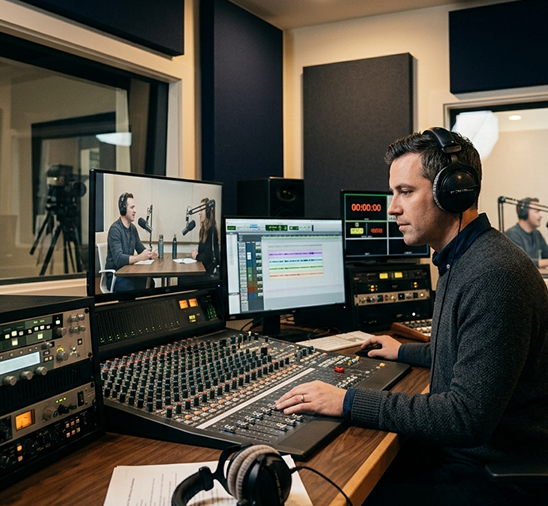
- production workflows for audio and video (sounding good AND looking good — double whammy)
- editing and quality control (did the guest spell their name with 2 T’s or just 1?)
- content repurposing systems (a podcast episode is at least 10 individual pieces of content if done right)
- distribution strategy across platforms (where is your audience actually hanging out?)
- ongoing optimization over time (the landscape keeps shifting)
What gets missed: a podcast is not a piece of content. It’s an engine. Vroom, vroom, vroom.
When teams ask me what a B2B podcast agency actually handles day-to-day, the answer is the engine — not just the content that comes out the other end.
Five honest questions to answer before you decide
Before deciding between DIY and an agency, I walk teams through five questions.
- Do you have a clear point of view worth listening to?
Not a product pitch. A perspective. Who wants to tune into a 30-minute commercial? I’ll tell you. No one.
- Do you know what success looks like beyond “publishing episodes”?
Leads, relationships, authority, recruiting, internal alignment? Pick the metric before you build the show.
- Do you have someone accountable for the podcast end-to-end?
Not contributors. Ownership. Who is driving the ship?
- Are you prepared for this to be a 6 to 12 month compounding channel?
This is not a short-term campaign. If we get on a call and you tell me you want to test 3 to 5 episodes before committing to a podcast, I’m going to tell you not to make a podcast.
- Are you willing to collaborate on creative and strategic direction?
Or do you expect the agency to figure it out alone?
If you’re still in the evaluation stage, the biggest mistakes brands make when starting a podcast cover a lot of the same ground from a different angle — worth a read before you commit to either model.
The hidden costs of DIY
DIY podcasting rarely fails because teams can’t do the work. It fails because the work expands, and podcasting is a slow, mighty burn.
The hidden costs usually show up in three places.
Time fragmentation
Podcasting touches a lot of key players — scheduling, editing, marketing, approvals. Slowly, it becomes everyone’s “side responsibility.”
Quality drift
Without a dedicated production system, episodes start to feel inconsistent. And consistency is the backbone of any new listener habit.
Continuity risk
If the internal owner leaves or gets reassigned, the podcast often stalls completely.
If outsourcing is on the table, the different podcast production service models are worth comparing before you talk to anyone.
DIY vs Hybrid vs Agency: a quick comparison
| Model | Works best when | Risk |
| DIY | You have a dedicated content or media team, a founder-host with a built-in audience, or podcasting is a core media pillar. | Time fragmentation, quality drift, owner turnover. |
| Hybrid | You have an internal host with strong perspective, but no production capacity. | Coordination overhead between internal voice and external execution. |
| Full agency | Publishing has become inconsistent, coordination is slowing execution, or repurposing has overwhelmed the team. | Higher monthly investment. Requires real collaboration on strategy. |
When DIY genuinely works (and the 3 team profiles that should stay in-house)
DIY can absolutely work, but only under very specific conditions. There are three profiles where in-house podcasting actually succeeds.
Founder-led brands with strong personal authority.
The founder is the distribution channel and already has a built-in audience. The founder also has time to develop show concepts and execute distribution. This founder may be a unicorn.
Companies with a dedicated content or media team.
Not general marketing. An actual production capability. You’ve got the podcast studio and the human power to operate it and develop the raw materials.
Organizations treating podcasting as a core media pillar.
Not a campaign. A system.
For teams operating at this level, the structural choice between interview-style and narrative podcast production becomes the next decision — and a bigger one than most teams expect.
When an agency pays for itself (and the math)
An agency becomes valuable when the cost of coordination exceeds the cost of production.
That tipping point usually shows up when:
- publishing becomes inconsistent
- guest coordination slows execution
- content repurposing becomes overwhelming
- quality starts depending on who is available
At that point, the ROI isn’t just “better episodes.” It’s consistency, speed, and sustainability. And consistency is what creates compounding returns.
For a sense of what that looks like in practice, our podcast production company overview and recent client work give the clearest picture.
The hybrid model: in-house host, outsourced production
One of the most effective models I’ve seen is hybrid:
- internal host owns voice and perspective
- agency owns production, editing, and distribution
This separation works because it isolates authenticity (internal) from execution (external). Both are critical. Neither has to live on the same person’s desk.
What to expect in the first 90 days with an agency
The first 90 days are about setting the foundation. Skip the foundation and you’ll be hanging up your headphones in a few short months.
A strong foundation usually looks like:
- defining the show strategy and positioning (what this podcast actually is in the market)
- clarifying guest profiles and episode structure (who you’re talking to and why it matters)
- locking the production workflow from recording to editing to approval to publishing
- establishing a consistent brand and audio/video identity
- batch recording to build a content buffer, so the team is never recording to survive the week
- building the distribution and repurposing system so each episode compounds across channels
What surprises most teams is how quickly things stabilize once there’s a real system in place. The chaos they expected from podcasting usually shows up before launch, not after.
The end result is a podcast that runs without constant firefighting. Who has time for that?
How Resonate approaches the DIY-to-agency transition
At least half of my meetings each week are with companies ready to transition from DIY overwhelm to agency support. And I get it — the word agency is kind of scary. It’s not my favorite either. Consider us a team. Because that’s exactly what Resonate is.
We approach this transition by:
- aligning on business goals first (let’s define success, together)
- building production systems before volume (let’s build something sustainable, together)
- designing for both content and conversion (let’s measure real ROI, together)
- removing operational drag from internal teams (let’s save time, together)
See what I did there?
If agency support is the right next move, book a strategy call and we’ll talk through what your version of this transition looks like.