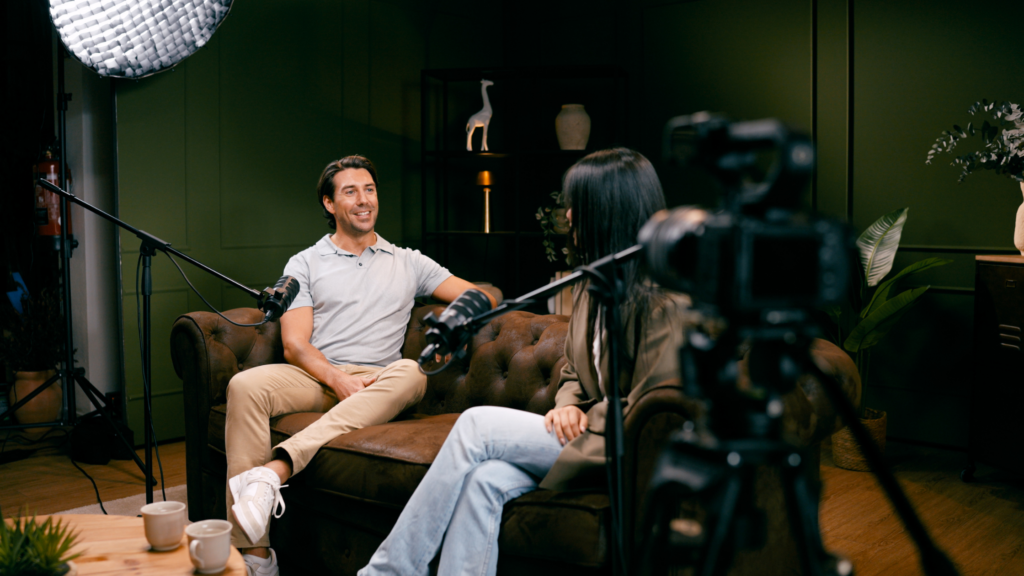




Two hires. Very different outcomes.
The question arrives on my discovery calls almost every week. “Should we hire a freelance podcast editor or work with a production company?” The person asking has already decided to invest in podcasting. They are not asking whether to start. They are asking how to resource the show correctly.
That makes this one of the most important decisions a B2B marketing team makes when launching a podcast. Choosing wrong does not just cost money. It costs months of internal burnout and a show that quietly stops working. Resonate Recordings is a podcast production agency that has produced 50,000+ episodes across 12+ years. We hear this question on almost every fifth discovery call.
The right answer depends on four things. This guide walks through all of them.
When I get that question on a discovery call, I do not stop at one follow-up. I usually ask several. How often do you want to publish? Are the shows publishing on time important to you? Are you sure this person has a reliable track record of being on time? How many other shows is this freelance editor working on? Do they have a backup plan if they cannot get to your latest episode? Are they outsourcing your edits? Do you know who may be working on your episodes if it is not your freelancer?
Usually they have an answer to the first question but not the ones that follow. That gap tells me everything I need to know.
What This Guide Does Not Cover
This guide does not cover recording equipment, hosting platforms, or editing software. It does not compare individual freelance editors or agencies by name. It does not address consumer podcasting.
This guide covers one decision: how to resource a B2B podcast that is expected to generate measurable business outcomes. If your show does not need to perform for the business, this guide is not for you.
This guide also assumes you have already decided to spend money on outside help. If you are still weighing whether to outsource at all, read our guide on when to hire a podcast agency versus going DIY first. That decision comes before this one.
Freelance Editor vs. Production Company: The Quick Reference
| Freelance Editor | Full-Service Agency | |
|---|---|---|
| Core function | Audio and video post-production | Strategy, production, distribution, and growth |
| Internal hours required | 6-10 hrs per episode | Under 1 hr per episode |
| Strategy included | No | Yes |
| Host development | No | Yes |
| Launch planning | No | Yes |
| Growth accountability | No | Yes |
| Typical monthly cost | $300+ per episode | Depends on scope; contact for scoping |
| Best fit | Shows with strategy and owner in place | Shows building from scratch or scaling |
For a full view of what a production partnership covers, see our podcast production services.
The Four-Branch Decision
This is the framework I use on every discovery call. Work through each branch in order. Your answer determines the next branch.
This is a decision tree, not a checklist. If your answer at any branch points to a production company, stop there. Do not continue to the next branch hoping for a different result.
Branch 1: Do you have a solitary dedicated internal owner?
A solitary dedicated owner is not someone who can squeeze the show into a busy week. It is a person whose job includes the podcast, with protected hours that do not disappear when a quarter at work gets too busy.
This person manages guest outreach, episode planning, content direction, distribution, and promotion. They review the freelance editor’s work and advise on multiple revisions if needed. They are accountable when the show underperforms.
If yes: Move to Branch 2.
If no: Stop here. You need a full-service production company. A freelance editor handles audio and video. They do not absorb the 6 to 10 hours of coordination that lives upstream and downstream of every edit, without a designated owner; that work lands on whoever is closest to the show. We call that person the Accidental Producer. More on that below.
Branch 2: Do you have a defined podcast strategy?
A defined strategy means you can answer all of the following without pausing to think.
- Who is the ideal listener, by role and industry?
- What specific problem does this show solve for that listener?
- What does the content calendar look like for the next 90 days?
- What does realistic success look like at 6 months, 12 months, and 24 months?
- How does the show connect to an ROI metric?
“We want to build thought leadership” is not a strategy. It is a loose goal. Strategy is what distills the goal to be more precise and connects the now precise goal to a strategic execution.
If yes: Move to Branch 3.
If no: A freelance editor cannot supply strategy. Strategy is not a production function. You need a partner whose scope includes strategic work before the first episode is recorded.
A freelance editor is not the right hire when strategy is missing. See how our engagements work to understand what the strategy phase of a full-service engagement actually covers.
Branch 3: How many episodes per month?
One to two episodes per month is manageable inside a freelance editor-only model, provided Branches 1 and 2 are covered.
Three or more episodes per month introduces coordination work that breaks freelance editor-only setups. Guest booking, briefing, scheduling, editorial review, and distribution multiply with volume. At three or more episodes per month, a solo freelance editor cannot cover what the show actually needs.
If one to two (max): Move to Branch 4.
If three or more: A full-service setup covers the coordination load that a freelance editor-only approach cannot sustain at that volume.
Branch 4: What is the growth goal?
There are two honest versions of this question.
Version A: The show should exist, be professional, and serve an existing audience that is not expected to grow significantly. A freelance editor handles this well.
Version B: The show should grow, generate inbound business, rank for search terms, and run for multiple seasons. This requires a team accountable for those outcomes, not just for the audio and video quality.
If Version A: A freelance editor is likely the right answer. Continue to the next section.
If Version B: A full-service production company is the path.
When a Freelance Editor Is the Right Answer
Not every B2B show needs a full-service agency. A meaningful segment of B2B podcasters fit the freelance editor-only profile well. Here is what that looks like.
- The show has been running for at least 12 months with an established format.
- One person owns the show with five or more protected hours per week.
- Strategy is locked: the ideal listener is defined, episodes are planned six weeks ahead, and content direction does not shift each quarter.
- The goal is consistent quality, not audience expansion.
- The budget covers editing but not a full-service partnership yet.
A freelance editor at this stage costs $300+ per episode, depending on episode length and whether video editing is included.
Here is the honest version of what a freelance editor-only setup actually means for a B2B podcast.
It makes sense when you want to have a podcast. Period. Nothing else. You just want to say that you have a podcast and you have a link on your website and streaming platforms for people to go listen.
Maybe you are telling yourself this is just the starting point. In a year or two, you will work with a podcast agency once you have grown the audience. Well, what is your plan to grow your audience? What is your freelance editor’s plan to grow your audience?
Can you and your team survive a year or two as accidental producers without burning out?
Or will your budget get eliminated by leadership because the podcast has no ROI or audience growth, because it was never built for that?
If you want a podcast with an established strategy and ROI plan before you invest thousands of dollars and hours, start with an agency first.
The Accidental Producer
This is the most common failure mode in freelance editor-only setups. We call it the Accidental Producer.
The Accidental Producer is a marketing manager, content strategist, or operations lead who agreed to help coordinate the podcast at launch. Six months later, they are doing all of the following.
- Managing the editorial calendar and keeping it 6 weeks ahead.
- Chasing guests and handling all scheduling.
- Briefing the editor before each episode and reviewing the finished audio and video.
- Writing or reviewing show notes, chapters, and social copy.
- Managing the distribution checklist across every platform.
- Handling guest follow-up and thank-you emails.
None of that is in their job description. All of it is eating their week. And now you are paying a freelance editor for your podcast AND the salary of one or two of your best company leads.
This happens because a freelance editor handles post-production only. Everything before the edit and everything after the publish still requires a human. When a company hires a freelance editor without designating a real internal owner, that coordination work distributes itself to whoever is most reachable.
The Accidental Producer rarely reports the overload until they are already burning out. By then, the show is behind, episodes are inconsistent, and the business has no clear picture of what happened.
By month 6, an accidental producer is faced with the fact that they now have an additional part-time job on top of their current full-time one. Also, the task of deciphering and defining podcast analytics for their team and leadership. Good luck with that. This job is not for the faint of heart.
A podcast is not a marketing campaign. It is not like tracking an awareness campaign or a conversion campaign. It is a feat of sustainability and consistency first, and once that is established, you have to figure out how to make the sustainability grow.
Typically, B2B podcasts come to me after that first year because their podcast is not growing and sometimes even receding.
They worked so hard for a year just to have our team scrap the model they built and thought they had perfected. Their podcast was never actually built to grow.
What Changes at Episode 20
Episode 20 is a real inflection point in freelance editor-only shows. By that point, four things have accumulated.
Guest pipeline pressure. The easy guests are exhausted. Internal executives and close contacts have recorded. Reaching new guests now requires outreach systems, follow-up sequences, and scheduling infrastructure. A solo editor is not resourced to provide that.
Content drift. Without a strategy layer actively enforcing the show’s direction, episodes start following whoever was available to record. The original audience positioning, if they had one, begins to blur.
Quality plateau. The freelance editor has standardized the audio and video. The thing limiting the show is no longer the production consistency. It is the questions asked, the host preparation, the episode structure, and the show concept. Those are strategy problems. A freelance editor cannot fix strategy problems.
Internal owner fatigue. If coordination has landed on one person, episode 20 is approximately when that person is spending more time managing the show than contributing to it. The signal is usually a call that starts: “The show is fine, but it feels like it’s going nowhere.”
That call is not a soft ask. It is a loud “I cannot do this anymore.” The accidental producer has been asking their company for agency help for months, and nobody gets it. I get it. They see that I get it. That call is always a moment where they can see light at the end of the tunnel.
I know how much work this takes. I spend the call as a pseudo-therapist listening to their podcast trauma.
We go over solutions to help with the heavy lift of a B2B podcast, discuss strategies to help the show grow, and find a budget their company is comfortable with.
When to Move From a Freelance Editor to a Production Company
The upgrade decision is not triggered by frustration with the freelance editor. A good freelance editor doing their job well cannot be blamed for strategy problems they were never hired to solve.
The upgrade is triggered by a change in what the show needs to do. Three signals that the time has come.
- The show needs to grow its audience, and the internal owner is already at capacity.
- ROI for the business is becoming a goal, and the current setup has no measurement infrastructure for it.
- The editorial direction needs a reset, and nobody internally has capacity to drive it.
Our podcast management service is built for shows that have cleared the freelance editor phase and are ready for a team accountable for growth outcomes.
If you are starting from scratch and want strategy built alongside production from day one, our podcast launch service covers both from kickoff through the first live episode.
Making the Right Call
The freelance editor versus agency decision is really a question about ownership and scope. If your team owns the strategy and has the internal bandwidth, a freelance editor could be the right starting point.
If either of those is missing, hiring a freelance editor is not saving money. It is deferring the cost of a show that will eventually stop working and need rebuilding. Resonate Recordings has produced 50,000+ episodes for clients including Amazon, Salesforce, Stanford, Honda, Mars, EA Sports, AbbVie, and Schneider Electric. We hear this question on almost every fifth discovery call.
Work through the Four-Branch Decision above and trust what it tells you. If you end up at a full-service partner, see the clients we have served or read how our engagements are structured before getting in touch.
When you are ready to talk, book a call here with me.