
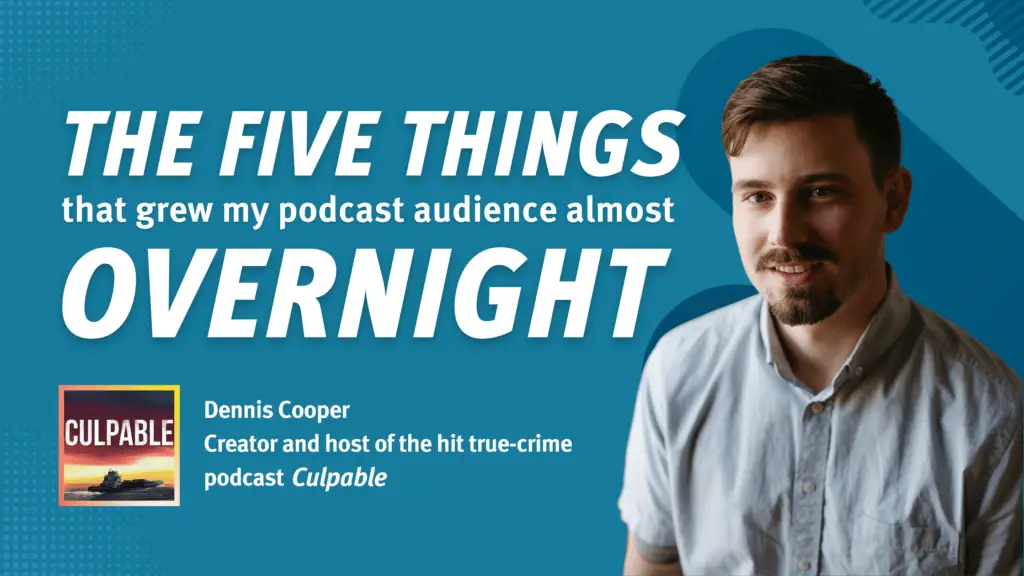
Nothing grew my podcast overnight. Not one thing. Not any of the tactics I list below. But five things compounded over ninety days and by the end of the third month the growth felt overnight.
I want to be honest about that from the start because the guides that promise overnight growth are lying. My download numbers roughly quadrupled between month one and month three. That is real growth. It was also the result of five specific moves running in parallel, not one lucky break. As part of a podcast production agency that works with hundreds of shows, I have watched this same pattern repeat across client shows too.
Below, the five things in the order they actually started working. Plus a comparison table with time-to-setup and when each move began paying off. Plus an honest section on what I tried first that produced nothing. Plus a note on the trap that almost stopped me from finishing the ninety days.
I have produced audio at Resonate Recordings since 2019. My personal podcast started in 2023 as a hobby project on the side. It stayed at 200-400 downloads per episode for the first year. In early 2025 I ran the five moves below over about ninety days. Downloads passed 1,600 per episode by day 90 and have compounded since. The show now sits comfortably above 4,000 downloads per episode a year later. This is what worked, what did not, and what I would do differently starting fresh.
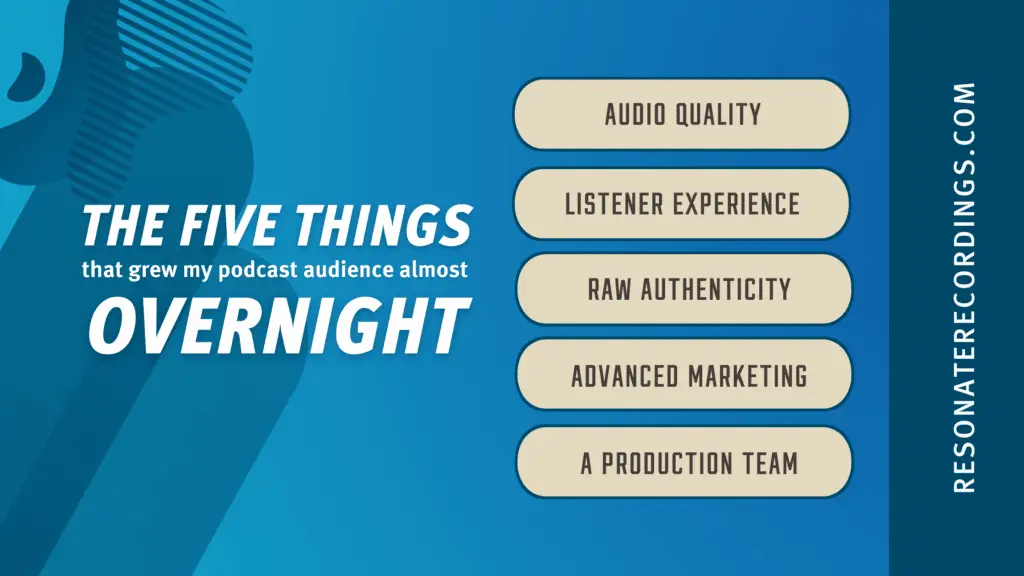
The 5 Things (In the Order They Started Working)
Five specific moves running in parallel over ninety days. Each one starts paying at a different point in the timeline. That is why any single one felt slow but the combined effect felt overnight.
1. I Rewrote Every Episode Title With a Specific Keyword
My titles used to sound like inside jokes. Cute for existing listeners. Invisible to search. I spent one afternoon rewriting the last twenty episode titles to include the specific thing each episode was about. Industry data shows keyword-in-title correlates with about an eighteen percent discoverability lift on Apple Podcasts. Listeners are also 2.6 times more likely to discover a show through an episode title than through the show title itself.
The specific move that mattered most: I stopped writing titles for people who already knew the show. I started writing them for people searching Google or Apple Podcasts for a specific topic. My old title format was a clever phrase and a guest name. My new title format was the specific outcome or question the episode delivered, plus the guest name only when the guest was a search draw. Small change, real numbers. I also went back and updated the last thirty episodes, not just new ones. Old episodes still get discovery traffic on Apple Podcasts and Google. Updating them was the same afternoon of work and roughly doubled the impact.
The change started paying by week two. Search-driven downloads went from essentially zero to a small trickle. The trickle grew into a real percentage of monthly downloads by week eight. This is the fastest single-afternoon move on the list. Our review of how podcasts make money at different audience sizes covers why search-driven listeners often convert better than social-driven ones.
2. I Started Cutting 3 to 5 Vertical Clips From Every Episode
Short-form video on TikTok, Instagram Reels, YouTube Shorts, and LinkedIn is the primary discovery channel in 2026. I resisted this for months because clipping felt like extra work. The extra work is real. Three hours per week for a weekly show, roughly. The impact took about six weeks to show up in download data but became consistent after that. The best clips deliver a complete idea in thirty to ninety seconds. Volume matters: four to five clips per week trains the algorithm to find your audience.
3. I Built an Email Newsletter From Episode One
This is the move I wish I had started years earlier. A weekly email that recapped the episode, pulled one key takeaway, and linked to the show. It took maybe an hour to write each week. The email list grew linearly, but its impact on downloads grew exponentially. By the time the list crossed five hundred subscribers, the weekly email alone drove a baseline of downloads that made the show sustainable regardless of algorithm shifts. Our piece on the podcast website that drives growth covers the email-capture setup I use.
The other reason to build the list early: it is the only audience I actually own. Spotify can change its algorithm and I lose recommendation traffic overnight. Apple can change its charts and my discovery drops. TikTok can bury my clips. None of those platforms can touch my email list. Every subscriber is a permanent distribution channel I control, not a rental from someone else’s platform.
4. I Booked Bigger Guests Than My Show Deserved
The trick was asking. Most creators I looked up to had an email address on their website or a form. I sent thirty to forty pitches over the ninety days. About twelve turned into recorded episodes. Each one brought fifty to two hundred new listeners from the guest’s audience through referral spikes. The guests who promoted the episode themselves brought closer to two hundred. The guests who did not still brought fifty from casual social mentions.
The reason to ask bigger than your show deserves: the worst that happens is a polite no. The best that happens is a five-figure audience discovers your show for the first time. Our podcast management service runs the guest-outreach workflow at scale for client shows.
5. I Rebuilt My Show Notes as SEO-Ready Blog Posts
Old show notes: three bullets and a link. New show notes: full transcript, structured headings, keyword-rich intro, related-episode block. Roughly forty-five minutes per episode to build. The Google traffic started arriving by week eight and has grown every month since. Web-browser listening is now 7.3 percent of total podcast listens according to Buzzsprout, up from 5.4 percent the previous year. That number keeps climbing. Our guide to how to record a podcast covers the recording quality standard that makes the transcript readable.
The Five Moves at a Glance (Comparison Table)
Each of the five moves takes different time to set up and pays off at a different point in the timeline. This is why running them in parallel felt faster than picking one and executing it first.
| The move | Time to set up | Impact horizon | When it started working |
|---|---|---|---|
| Rewrote every episode title with a keyword | One afternoon | Per-episode lift | Week 2 |
| Cut 3-5 vertical clips from every episode | 3 hours per week | Compounds over months | Week 6 |
| Started an email newsletter from episode one | One hour weekly | Compounds indefinitely | Week 4 |
| Booked bigger guests than my show deserved | 10 hours per month outreach | Per-guest audience spike | Guest 3 onward |
| Rebuilt show notes as SEO-ready blog posts | 45 min per episode | Long-tail search traffic | Week 8 |
What I Tried First That Produced Nothing
Before the five moves that worked, I tried a lot of things that did not. Three of them cost me time I should have spent on the real tactics. I named them so you can recognise them faster than I did.
The Announce-and-Pray
Posting a Twitter and Instagram announcement every time a new episode dropped and expecting the algorithm to do the rest. Zero engagement in most cases. The announcement post is not content. It is the equivalent of shouting into a hallway. The fix is turning each episode into distinct pieces of content for each platform, which is what the vertical clips move does.
The Grand-Guest Chase
Spending six weeks emailing three A-list guests hoping one would say yes. All three said no or did not reply. Meanwhile I could have sent forty smaller pitches and landed twelve. The grand-guest chase feels like efficient use of outreach time. It is actually the opposite. Volume with realistic targets beats concentration on unrealistic ones almost every time.
The Perfect-Cover-Art Trap
Spending three weekends iterating on cover art before I felt ready to promote the show. Cover art matters and there is real data on this. A case study by Podcast Marketing Academy showed a 45% growth spike from a cover-art redesign. But the trap is treating the art as the growth lever when the actual growth is somewhere else in the funnel. Fix the art once, then move on. Our review of the best podcast apps and how they surface art covers where the art actually shows up.
What I Cannot Promise You
Three honest caveats before you copy the playbook. I can tell you what worked for me. I cannot tell you it will work for you the same way.
Your Niche May Reward Different Moves
I make a show in a category where search-driven discovery works. If your show is in a category where discovery runs through app charts rather than search, the title move may pay less and the clip move may pay more. I cannot tell you which specific move will move your needle first. I can tell you that stacking all five in parallel gives you the best odds.
The Compounding Is Not Guaranteed
Some shows run the same moves for ninety days and see minimal change. The usual reason is that the show itself has a retention problem, not a growth problem. Listeners arrive and do not come back. Growth tactics can bring listeners to a leaky bucket. Fix the retention first.
The Quotable Verdict
Nothing grew my podcast overnight. Five things compounded over ninety days and it felt overnight. That is the honest verdict. If you take one thing from this post, take that. The compounding is real. The overnight is not. Marketing agencies running client shows use this same playbook and often partner with a white-label podcast production service to run it across a client roster.
Run All Five Moves for Ninety Days Before Judging Any of Them
If I could tell my past self one thing about growing a podcast, it would be this. Do not test the tactics one at a time. Run all five together for ninety days. Each one starts working at a different point in the timeline. Any single one, in isolation, feels too slow. The five together, running in parallel, feels like overnight growth by day ninety. That is the actual mechanism most growth stories are describing when they say a show blew up. Not one lucky break. Compounding.
The five: rewrite the titles, clip the episodes, build the email list, book the guests, rebuild the show notes. In that order of quickest to slowest payoff. All five for ninety days. Judge after that.
If you want help running these moves at production quality, book a podcast strategy call with our team.
Strategy-first. Production second. Growth always.